
Database search results
Back to simple search | Back to advanced search
- Completeness: 2
- Sort: updated
- Show this many records per page: 10
You searched for:
Record ID: MAS-D100128
Object type: HINGE
Broad period: NINETEENTH CENTURY
Workflow stage: Published 
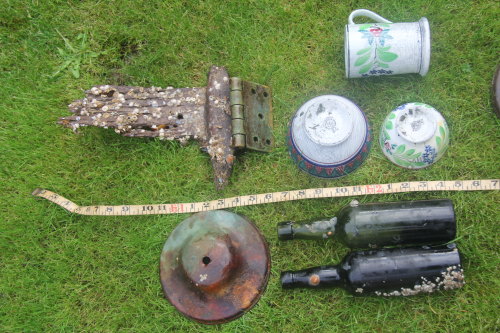
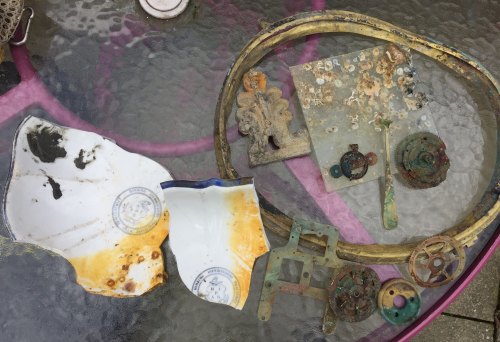
This record refers to the metal hinge and attached timber shown in the top left corner of image one, the other finds are dealt with under separate records.
The object is approximately 305 mm in overall length and 204 mm in overall width. For the hinge element of the object only one leaf can be observed from the photo, which measures approximately 64 mm by 127 mm. Given the leaves are likely to be identical in size, this would suggest the overall width is approximately 127 mm making a regular square when fully opened. The metal of the hinge is in generally good condition, with some blu…
Created on: Monday 9th October 2017
Last updated: Wednesday 22nd April 2020
No spatial data available.
Record ID: MAS-D100173
Object type: CLOCK
Broad period: NINETEENTH CENTURY
County: Kent
Workflow stage: Published
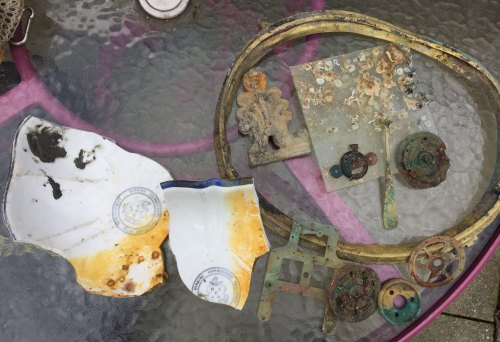
This record refers to the clock parts recovered as part of a group of finds. The finder described the items as 6 clock parts, the square glass from the clock face and the copper clock face from a grandfather clock, which suggests these finds represent parts of two separate clocks.
Three of the clock parts, manufactured in a copper alloy, are circular and bear teeth around their circumference indicating they are part of the clockwork mechanism. Two other parts, also in copper alloy, are circular but without evidence of teeth. One has three screw holes arranged around a central circular…
Created on: Wednesday 2nd May 2018
Last updated: Thursday 9th April 2020
Spatial data recorded.
Record ID: MAS-D100230
Object type: BOTTLE
Broad period: NINETEENTH CENTURY
County: Kent
Workflow stage: Published
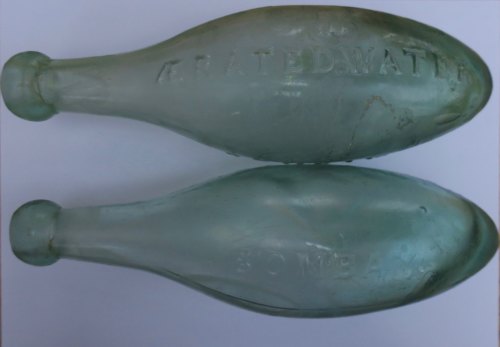
Three bottles of blown glass. The frst two bottles are torpedo or Hamilton´s type bottle (Hamilton introduced this type of blow molding) from the mid-nineteenth century dedicated to containing carbonated water or 'soda'. Both are light blue/green 'aqua' glass and measure 250 mm long and have a diameter of 75 mm with a 'bottom-weighted' blob finish. The inscription "Aerated Water" "Bombay" makes reference to the content and place of distribution, something that manufacturers of this type of packaging commonly did. The design ensured that the bottles would be stored on their side, keepi…
Created on: Tuesday 2nd October 2018
Last updated: Wednesday 1st April 2020
Spatial data recorded.
Record ID: MAS-O100189
Object type: NAIL
Broad period: POST MEDIEVAL
County: Greater London Authority
Workflow stage: Published
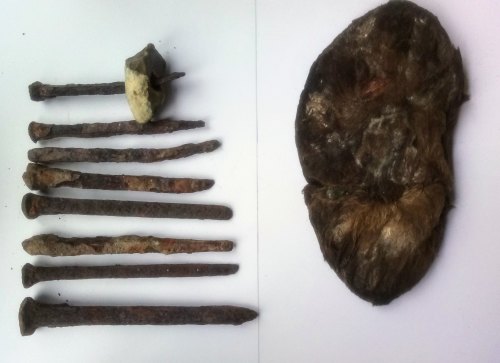
The find consists of 8 iron nails and an unidentifiable object that contains one further nail and is made of, or covered in, what appears to be fur.
The nails range in length from 135 - 175 mm, and c. 10 - 20 mm in width at their widest point below the head. All 8 nails have a rose type head and taper to a broad point. These features suggest that the nails were hand wrought, rather than cut or wire, a method where each nail is manufactured individually by hand on a blacksmiths anvil. The invention of the slitting mill c. 1590 simplified this process by manufacturing iron rods from whi…
Created on: Wednesday 13th June 2018
Last updated: Monday 30th March 2020
Spatial data recorded.
Record ID: MAS-O100234
Object type: BARREL
Broad period: POST MEDIEVAL
County: Down
Workflow stage: Published
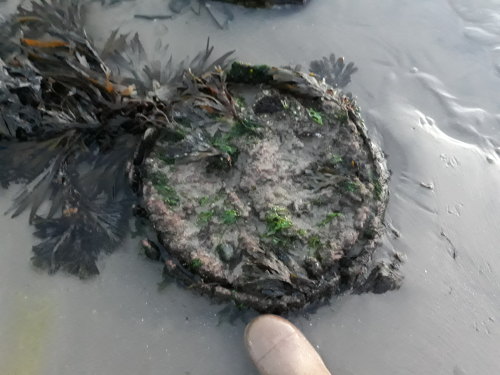
This find comprises of the remains of three to four wooden barrels, which were buried in the intertidal sandy substrate of a pleasure beach. The action of the tide revealed the barrels and it is unclear how much of the barrels remain. End of the staves, lengths of timber making the sides of the barrel, are visible and clearly degraded. In some cases these give the appearance of flaring outwards, implying that only the lower portion of the barrel remains. At least one barrel exhibits inwardly projecting staves, suggesting more than half of the barrel remains. There is some evidence for …
Created on: Monday 15th October 2018
Last updated: Monday 30th March 2020
Spatial data recorded.
Record ID: MAS-D100134
Object type: HANDLE
Broad period: POST MEDIEVAL
Workflow stage: Published
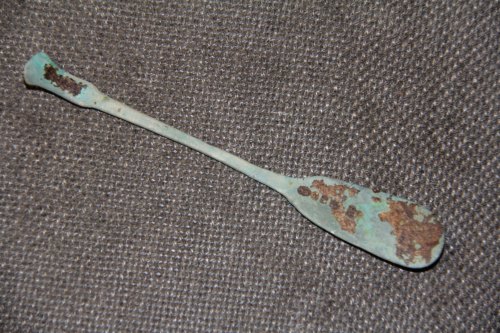
The stem of a silver fork or spoon with a hallmark pattern.
The set of four hallmarks located together on the piece of cutlery indicates it was made later than 1781, when this practice was first introduced. Based on this image, this type of spoon/fork is possibly a Fiddle pattern - this refers to the shape of the handle - and is a type introduced in the 1780s and still in production today. The Fiddle pattern means that there are shoulders on the stem near the bowl, which is seen on this example. The lower end of the stem juts out around 90 degrees but this example may have been worn d…
Created on: Monday 23rd October 2017
Last updated: Monday 30th March 2020
No spatial data available.
Record ID: MAS-F100172
Object type: AIRCRAFT COMPONENT
Broad period: MODERN
Workflow stage: Published
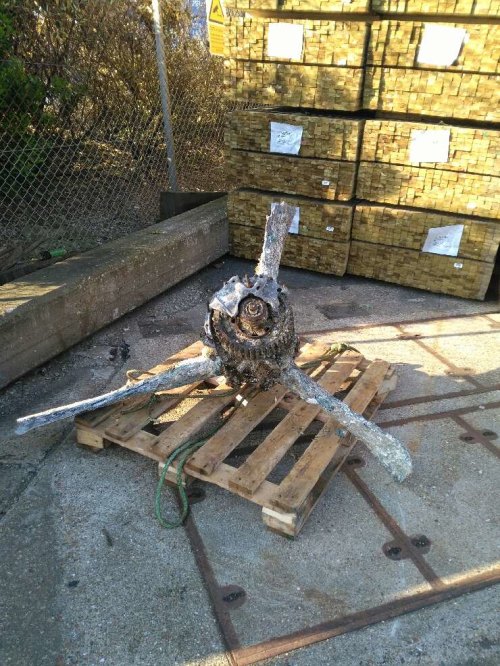
Rolls Royce Merlin 45 gear unit, serial number GU 69 677, with a truncated, heavily damaged and corroded, three bladed propeller. All three propeller blades have survived despite heavy corrosion, though the end of one is missing. The wiring in the propeller cam shaft is visible since the outer dome casing has partially disintegrated. The Merlin 45 engine was used in the Mk. V Supermarine Spitfire fighters, in Reconnaissance Spitfires (PR Mk. IG & P MK. IV), and early versions of the naval version the Supermarine Seafire Mk. IB and Mk. IIC). The Merlin 45 saw active service from ear…
Created on: Friday 27th April 2018
Last updated: Friday 27th March 2020
No spatial data available.
Record ID: MAS-O100169
Object type: KNIFE
Broad period: POST MEDIEVAL
County: Isle of Wight
Workflow stage: Published
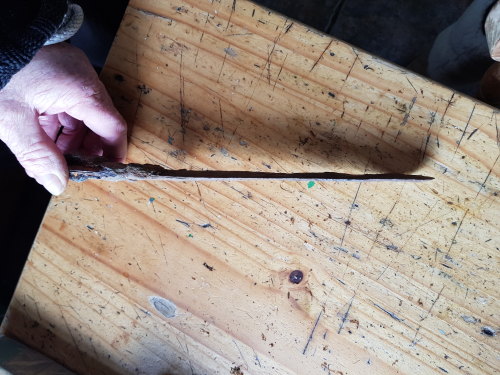
Double edged blade covered with concretions, around 25 mm wide and 280 mm long. Displays iron oxidation, and the item has not been preserved well. The blade is roughly 200 mm long and the thicker handle is approximately 80 mm long.
Following consultation with Henry Yallop of The Royal Armouries museum, this object can only be discribed as roughly the shape of a common blade form , i.e. roughly lenticular, and about 25 mm broad. What is not clear is whether it was once the complete blade, or that this is part of one, or alternatively that it was the part of another forged object, and o…
Created on: Saturday 20th January 2018
Last updated: Thursday 26th March 2020
Spatial data recorded.
Record ID: MAS-D100174
Object type: CUTLERY
Broad period: NINETEENTH CENTURY
County: Kent
Workflow stage: Published
This record refers to the handle of a metal spoon or fork included within this group of finds. The diagnostic end of the piece is broken and therefore is uncertain whether this is a fork or spoon, and a lack of measurements precludes determining whether this is a tea or desert size in terms of spoon , or cake or main course size of fork. The fabric of the item, though slightly coroded, has a yellowish colour which may indicate gold or gold plating has been used in its manufacture. Alternatively, given the verdigris colour of the corrosion, may have been constructed in a copper alloy or…
Created on: Wednesday 2nd May 2018
Last updated: Thursday 26th March 2020
Spatial data recorded.
Record ID: MAS-D100178
Object type: TOOTHBRUSH
Broad period: POST MEDIEVAL
County: Dorset
Workflow stage: Published
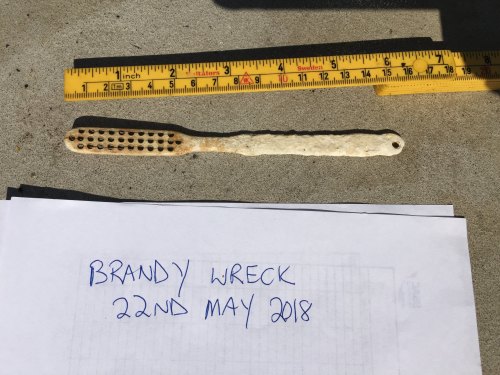
This find consists of a brush handle and head manufactured from either bone, horn or ivory, with the bristles missing. The item is approximately 160 mm in overall length, with the head being c. 60 mm, a neck of c. 20 mm and a handle of 80 mm. The head of the brush is c. 15 mm wide, the neck c. 8mm and the handle c.10 mm. There is a small hole in the end of the handle, presumably for accomodating a lanyard or for hanging the brush from. In the head there are 32 holes for accomodating the bristles, with channels recessed and filled on the rear face where the bristles would have been secu…
Created on: Friday 1st June 2018
Last updated: Thursday 26th March 2020
Spatial data recorded.
Records per page: 10 20 40 100
Sort your search by:
Which direction?
Total results available: 28
Search server index: valhalla
You are viewing records: 1 - 10.
Search statistics
- Total quantity: 41
- Mean quantity: 1.464
- Maximum: 6
Filter your search
Object type
All Object type optionsCounty of origin
Broad period
Institution
Material
All Material optionsWorkflow
1 - 10 of 28 records.

About us
About our site

Data labs
Find us
Wessex Archaeology
Portway House, Old Sarum Park
Salisbury SP4 6EB
T: +44(0) 1722 326867
E: