Database search results
Back to simple search | Back to advanced search
- Discovery: Diving
- Page: 6
- Show this many records per page: 10
- Sort: broadperiod
You searched for:
Record ID: MAS-D100084
Object type: BOTTLE
Broad period: NINETEENTH CENTURY
County: Kent
Workflow stage: Published 
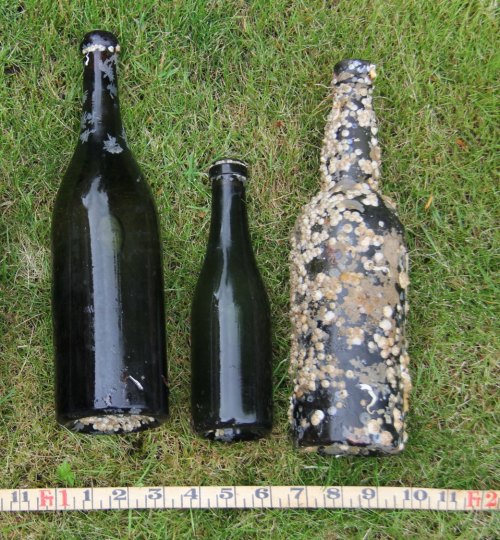
Three cylindrical glass bottles. The two larger bottles are full size wine bottles. One is of the 'Burgundy' type and is most likely Continental. The half-size wine bottle, originally thought to be a champagne bottle, also has a Continental style neck. The Continental style neck appears around the middle of the 19th century (Dumbrell 1983). All are of nineteenth or twentieth century type.
Created on: Friday 11th August 2017
Last updated: Wednesday 6th December 2017
Spatial data recorded.
Record ID: MAS-D100100
Object type: BOTTLE
Broad period: NINETEENTH CENTURY
County: Kent
Workflow stage: Published
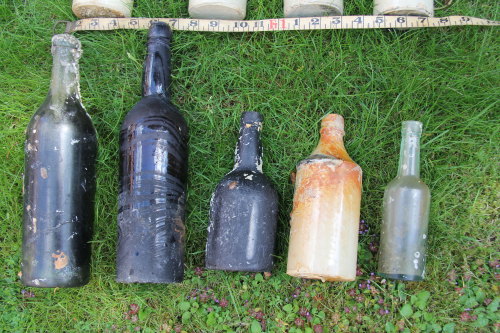
A collection of five bottles comprising two full-size glass bottles, one squat cylindrical glass bottle, one small clear bottle, and one stoneware bottle. All the bottles are believed to be of nineteenth and twentieth century type, although it is difficult to date all but the stoneware bottle.
The two full-size glass bottles are thought to be either wine or beer bottles. If the bottles have kicked bases, it would indicate a wine bottle, while a flat base would indicate a beer bottle.
The squat cylindrical glass bottle was thought to be a port bottle, however if the base is flat, thi…
Created on: Friday 11th August 2017
Last updated: Tuesday 22nd May 2018
Spatial data recorded.
Record ID: MAS-D100101
Object type: BOTTLE
Broad period: NINETEENTH CENTURY
County: Kent
Workflow stage: Published
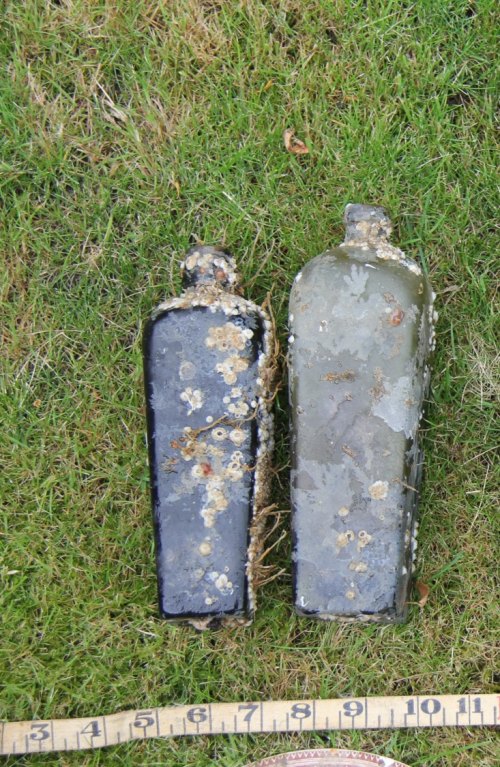
Two case gin bottles.
Some of the earliest liquor bottles were square in cross section and generally designed to contain gin though undoubtedly contained various types of liquor and possibly wine. Commonly called 'case gin' or 'taper gin' bottles since they would pack more efficiently in a case (6 to 24 bottles) than round bottles. Case gin bottles are square with a distinct taper inwards from the shoulder to the base. The neck is very short to almost non-existent with the finishes varying from a laid-on ring, flared, mineral finish, oil, and even a blob. This shape and style of bottl…
Created on: Friday 11th August 2017
Last updated: Tuesday 22nd May 2018
Spatial data recorded.
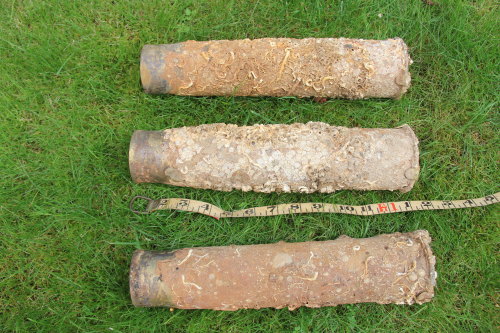
Record ID: MAS-D100115
Object type: CARTRIDGE
Broad period: NINETEENTH CENTURY
County: Kent
Workflow stage: Published
Images of this find were sent to Trevor Parker of the Ordnance Society. He confirmed that these three shell cases belong to a six-pounder Hotchkiss gun. This particular type of gun was introduced in 1884 for use against torpedo boats. They were used during First World War on the Arethusa and early 'C' class cruisers and a few submarines as well as on Monitors M.15 through M.33. Originally French in origin, they were introduced to Britain in 1886 (Tucker 2013). Many were subsequently used as sub-calibre and saluting guns which meant that they were still available in 1939 (Naval Weapons,…
Created on: Friday 8th September 2017
Last updated: Thursday 5th October 2017
Spatial data recorded.
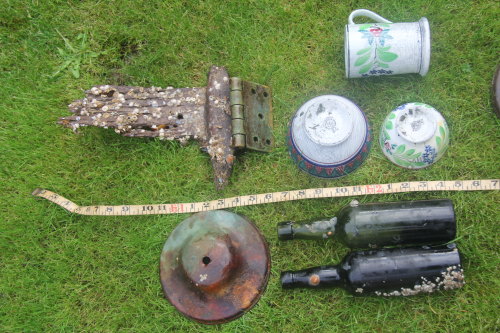
Record ID: MAS-D100128
Object type: HINGE
Broad period: NINETEENTH CENTURY
Workflow stage: Published
This record refers to the metal hinge and attached timber shown in the top left corner of image one, the other finds are dealt with under separate records.
The object is approximately 305 mm in overall length and 204 mm in overall width. For the hinge element of the object only one leaf can be observed from the photo, which measures approximately 64 mm by 127 mm. Given the leaves are likely to be identical in size, this would suggest the overall width is approximately 127 mm making a regular square when fully opened. The metal of the hinge is in generally good condition, with some blu…
Created on: Monday 9th October 2017
Last updated: Wednesday 22nd April 2020
No spatial data available.
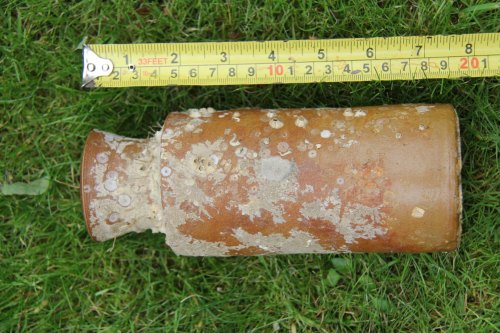
Record ID: MAS-D100132
Object type: INK BOTTLE
Broad period: NINETEENTH CENTURY
Workflow stage: Published
One stoneware ink bottle.
Ink bottles or inkwells were made of various materials including glass, various metals, various stones, various woods, horn, ceramics and stoneware, and even hard rubber. Prior to beginning of the 19th century, virtually all ink came in ceramic containers which were still commonly used throughout most of the 19th century. Stoneware bottles were superseded by glass bottles by the first decade of the 20th century. Ink bottles of this size are known as the bulk or master ink bottles (https://sha.org/bottle/household.htm, accessed March 2020). The master bottles …
Created on: Monday 23rd October 2017
Last updated: Monday 30th March 2020
No spatial data available.
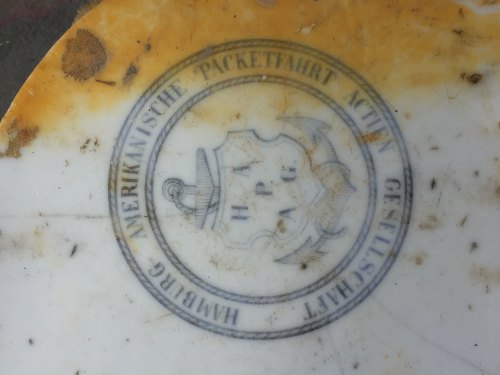
Record ID: MAS-D100138
Object type: CONTAINERS
Broad period: NINETEENTH CENTURY
County: Kent
Workflow stage: Published
Two shards of crockery with makers mark present. The stamp is made up of letters "H A P A G" and a stylised admiralty anchor which has a wooden stock behind a shield. "H.A.P. A.G" refers to The Hamburg Amerikanische Packetfahrt Aktien Gesellschaft; a German shipping company that operated from 1847 until 1970. The stamps would have been on the base of the corckery therefore it is not clear whether these pieces would have belonged to bowls or plates when they were in use. The shards are white, with dark flecked inclusions and yellowish patches. It is more than likely that these pieces we…
Created on: Wednesday 2nd May 2018
Last updated: Thursday 26th March 2020
Spatial data recorded.
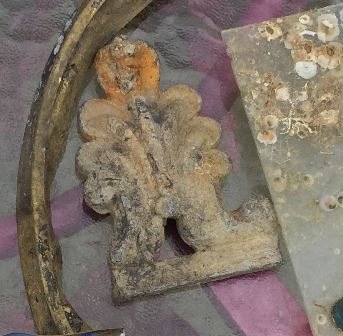
Record ID: MAS-D100146
Object type: UNIDENTIFIED OBJECT
Broad period: NINETEENTH CENTURY
County: Kent
Workflow stage: Published
Find consists of an ornate metal piece, bearing a flyr de lys type of design above a solid bar, presumably used for mounting. No dimensions were given, though it is suggested to be made from lead and H shaped, the finder described it as "part of a fireguard from the ship room". This material type would seem unsuitable for such a purpose, therefore it is still unclear what the purpose of this object is, although it is generally accepted that it is a decorative object of some sort.
Created on: Wednesday 2nd May 2018
Last updated: Thursday 26th March 2020
Spatial data recorded.
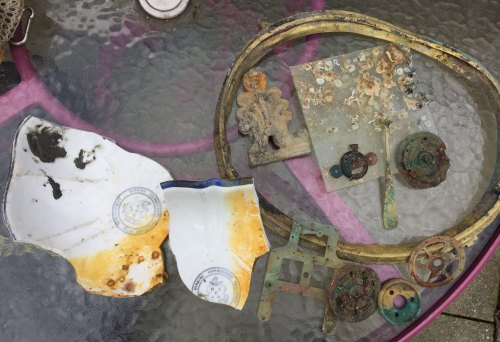
Record ID: MAS-D100173
Object type: CLOCK
Broad period: NINETEENTH CENTURY
County: Kent
Workflow stage: Published
This record refers to the clock parts recovered as part of a group of finds. The finder described the items as 6 clock parts, the square glass from the clock face and the copper clock face from a grandfather clock, which suggests these finds represent parts of two separate clocks.
Three of the clock parts, manufactured in a copper alloy, are circular and bear teeth around their circumference indicating they are part of the clockwork mechanism. Two other parts, also in copper alloy, are circular but without evidence of teeth. One has three screw holes arranged around a central circular…
Created on: Wednesday 2nd May 2018
Last updated: Thursday 9th April 2020
Spatial data recorded.
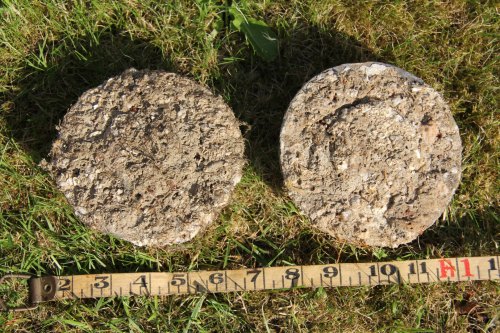
Record ID: MAS-D100175
Object type: SHIP FITTINGS
Broad period: NINETEENTH CENTURY
County: Kent
Workflow stage: Published
Two brass deck water filler plates and one ceramic door number (45).
The water filler plates are 150 mm in diameter and approximately 100 mm thick. They are both heavily degraded and concreted, distorting their 'mushroom-shaped' original form. It appears they have screws running through the wider top surface and hanging down below next to the tinner plug interior. The screws are approximately 50 mm long and 5 mm in diameter. This type of ships fiitting is used to provide an access point by which to fill water tanks on a vessel and are common on many vessels, from pleasure craft to com…
Created on: Wednesday 9th May 2018
Last updated: Thursday 26th March 2020
Spatial data recorded.
Records per page: 10 20 40 100
Sort your search by:
Which direction?
Total results available: 80
Search server index: asgard
You are viewing records: 51 - 60.
Search statistics
- Total quantity: 222
- Mean quantity: 2.775
- Maximum: 26
Filter your search
Object type
All Object type optionsCounty of origin
Broad period
Institution
Material
All Material optionsWorkflow

About us
About our site

Data labs
Find us
Wessex Archaeology
Portway House, Old Sarum Park
Salisbury SP4 6EB
T: +44(0) 1722 326867
E: