Database search results
Back to simple search | Back to advanced search
- Object type: bottles
- Page: 2
You searched for:
Record ID: MAS-D100066
Object type: BOTTLE
Broad period: NINETEENTH CENTURY
County: Kent
Workflow stage: Published 
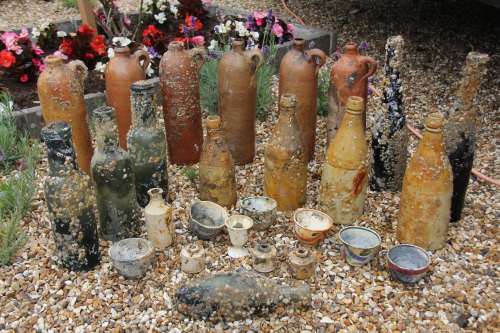
Four stoneware bottles (three large and one smaller) that were probably used for beer, ale, stout or porter.
Stoneware bottles provided the ultimate in protection from the detrimental effects of light but were very heavy. They were produced in Britain in the 1800s and many bottles found in the United States were even imported from here.
All of these bottles have a feldspathic glaze over an ochre dip on the upper parts of the bottle giving them a darker colour on top. Feldspars (natural rocks of aluminosilicates) are used in stoneware and porcelain glazes because they fuse only at hi…
Created on: Monday 24th July 2017
Last updated: Thursday 5th October 2017
Spatial data recorded.
Record ID: MAS-D100072
Object type: BOTTLE
Broad period: NINETEENTH CENTURY
County: Kent
Workflow stage: Published
One Hamilton bottle also known as a torpedo or egg bottle. These bottles are named after their English inventor, William Francis Hamilton who took out a patent in 1809 for a method of bottling soda and other mineral waters, involving ovate bottles (although use of ovate bottle probably pre-dated his patent by at least 20 years). These bottles became common in the 1840s when the manufacturing of mineral water became very popular. Before this date, carbonated water was only sold on a small scale. The bottle was invented as a way of keeping the gas in fizzy drinks. The pointed base meant …
Created on: Monday 24th July 2017
Last updated: Thursday 5th October 2017
Spatial data recorded.
Record ID: MAS-D100074
Object type: INK BOTTLE
Broad period: NINETEENTH CENTURY
County: Kent
Workflow stage: Published
A collection of four ink bottles; one large and three small.
The larger stoneware ink bottle displays a pourer on the rim and is glazed with a feldspathic glaze. This type of ink bottle was introduced in the 1860s and were superseded by glass bottles by the first decade of the 20th century. Cylindrical stoneware ink bottles were made in England in large quantities throughout the Victorian era. The bottles varied widely in size and were not all brown. The larger or master bottles with a pouring lip brown bottles were commonly used for ink. The pouring spout would be used to distribute …
Created on: Monday 24th July 2017
Last updated: Tuesday 21st November 2017
Spatial data recorded.
Record ID: MAS-D100063
Object type: BOTTLE
Broad period: NINETEENTH CENTURY
County: Kent
Workflow stage: Published
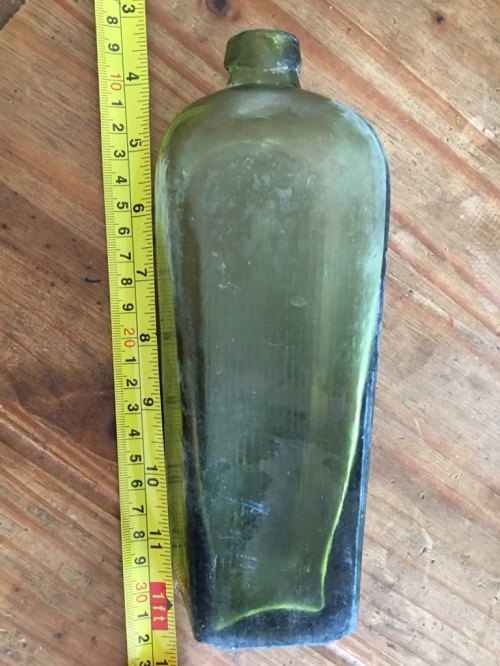
Five olive green case gin bottles with a square tapered body and four dots on base.
Some of the earliest spirit bottles were square in cross section and generally designed to contain gin, though undoubtedly contained various types of alcohol and possibly wine. Commonly called "case gin" or "taper gin" bottles since they would pack more efficiently to a case (six to 24 bottles) than round bottles. Case gin bottles are square with a more or less distinct taper inwards from the shoulder to the base. The neck is very short to almost non-existent with the finishes varying from a laid-on ri…
Created on: Saturday 15th July 2017
Last updated: Monday 30th March 2020
Spatial data recorded.
Record ID: MAS-D100080
Object type: PERFUME BOTTLE
Broad period: NINETEENTH CENTURY
County: Kent
Workflow stage: Published
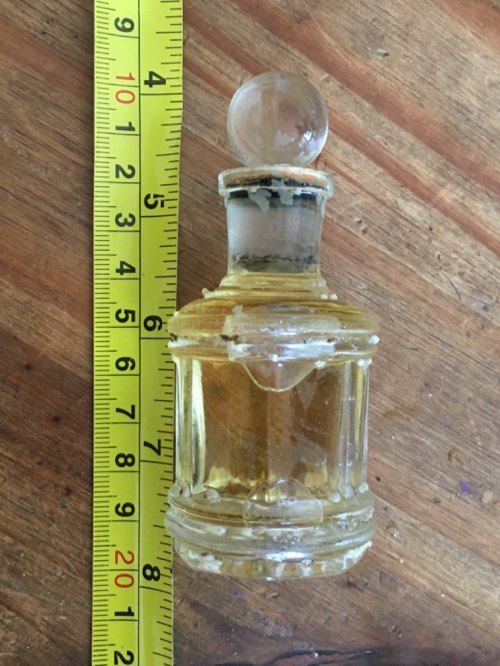
Two clear glass perfume bottles.
One has a square tapered body and measures 85 mm by 35 mm while the other measures 95 mm by 40 mm and has a round body complete with a round stopper and still contains yellow liquid. Perfume bottles were part of the vessel's cargo and many other bottles have been salvaged from the wreck by divers during recent years. Their form would be entirely consistent with a date around the turn of the 19th/20th century.
Created on: Saturday 15th July 2017
Last updated: Monday 30th March 2020
Spatial data recorded.
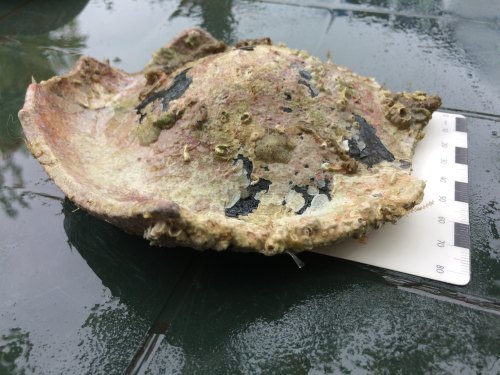
Record ID: MAS-D100045
Object type: BOTTLE
Broad period: POST MEDIEVAL
County: Dorset
Workflow stage: Published
Base of a broken glass onion bottle found loose on the seabed with quite a lot of marine growth present, including over the broken edges. Found on Marl Beds - not long after passing over an area of numerous fairly amorphous concretions apparently loose on the coarse sandy seabed.
Created on: Tuesday 30th May 2017
Last updated: Friday 28th February 2020
Spatial data recorded.
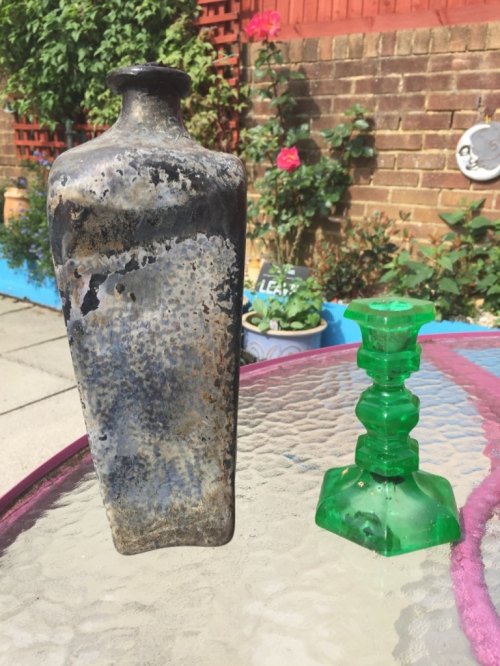
Record ID: MAS-O100053
Object type: BOTTLE
Broad period: POST MEDIEVAL
County: Kent
Workflow stage: Published
One gin bottle measuring 11 inches high by 3 1/2 inches wide. This square, mould-blown 'case bottle', has the typical tapering profile. The square shape enabled the bottles to be packed more efficiently in a case than round bottles, and the tapering profile stops them from sticking when removed from the case. They were used for gin (although undoubtedly also sometimes for other spirits or wine). Square case bottles were made in Europe from the middle of the 17th century, but the tapering form seems to have become more common in the 19th century. From the 1880s the bottles were machine …
Created on: Monday 29th May 2017
Last updated: Monday 19th March 2018
Spatial data recorded.

Record ID: MAS-D100040
Object type: BOTTLE
Broad period: POST MEDIEVAL
Workflow stage: Published
One onion bottle dated to c.1700.
Glass onion bottles were large hand-blown glass bottles, used aboard sailing ships to hold wine or brandy. For increased stability on rough seas, the bottles were fashioned with a wide-bottom shape to prevent toppling. Between c.1690 and c.1720 the outline of a wine bottle resembled an onion - a wide compressed globular body and a short neck (Robinson and Harding 2015). Most bottles before 1700 had a ring of glass just below the neck that gave anchorage to the string used to hold in variety of stoppers. The Dutch bottles usually had a longer neck than…
Created on: Tuesday 23rd May 2017
Last updated: Wednesday 4th October 2017
No spatial data available.

Record ID: MAS-D100038
Object type: BOTTLE
Broad period: POST MEDIEVAL
County: Kent
Workflow stage: Published
Four glass bottles that are all square, mould-blown 'case bottles', with a typical tapering profile. The square shape enabled them to be packed more efficiently in a case than round bottles, and the tapering profile stopped them from sticking when removed from the case. These were used for gin (although undoubtedly also sometimes for other spirits or wine). Square case bottles were made in Europe from the middle of the 17th century, but the tapering form seems to have become more common in the 19th century. From the 1880s the bottles were machine made, and the rims properly finished - …
Created on: Sunday 21st May 2017
Last updated: Tuesday 26th September 2017
Spatial data recorded.
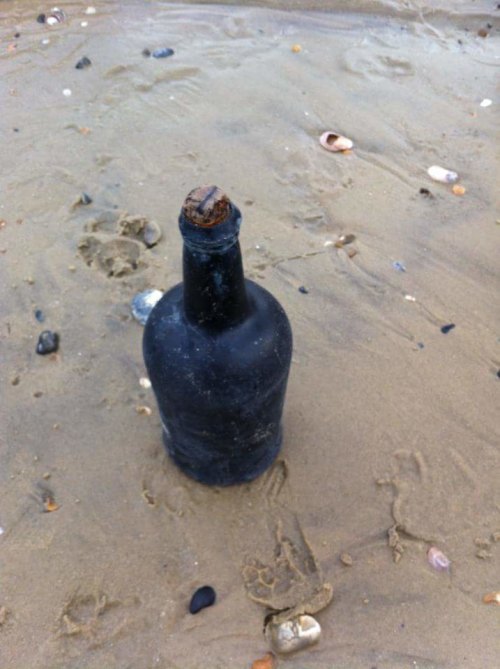
Record ID: MAS-O100028
Object type: BOTTLE
Broad period: POST MEDIEVAL
County: Isle of Wight
Workflow stage: Published
A bottle made from dark green/black glass, bearing a protruding cork. It has a slightly concave body, flaring moderately at the base, leading to gently rounded shoulders with clear definition where they intersect with the neck. The neck itself is broadly straight, tapering slightly where it meets the finish. The finish is of either a double oil or brandy type. The bottle is reminiscent of a spirit bottle of the squat cylinder style, though vessels of this style were used to contain a variety of products beyond beers, wines and spirits. Bottles of this type were manufactured from at lea…
Created on: Saturday 25th February 2017
Last updated: Friday 21st February 2020
Spatial data recorded.
Records per page: 10 20 40 100
Sort your search by:
Which direction?
Total results available: 30
Search server index: asgard
You are viewing records: 21 - 30.
Search statistics
- Total quantity: 78
- Mean quantity: 2.600
- Maximum: 6
Filter your search
Object type
County of origin
Broad period
Institution
Material
Workflow
21 - 30 of 30 records.

About us
About our site

Data labs
Find us
Wessex Archaeology
Portway House, Old Sarum Park
Salisbury SP4 6EB
T: +44(0) 1722 326867
E: