Database search results
Back to simple search | Back to advanced search
- Period from: POST MEDIEVAL
- Page: 2
- Sort: updated
- Show this many records per page: 10
You searched for:
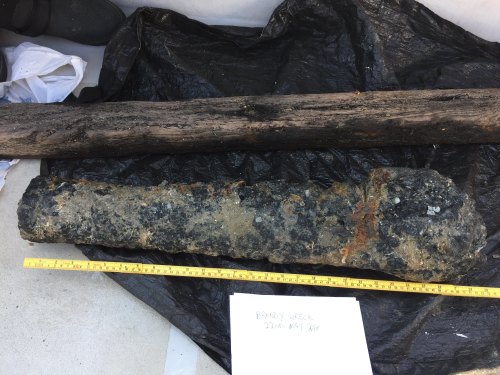
Record ID: MAS-D100180
Object type: CANNON
Broad period: POST MEDIEVAL
County: Dorset
Workflow stage: Published 
This item appears to be a small calibre black powder weapon, such as a swivel gun, commonly mounted on vessels throughout the age of sail as well as being used in terrestrial settings. The weapon is approximately 750 mm in overall length, with external muzzle diameter of approximately 110 mm flaring to an external diameter of 180 mm at the breech end. The condition of the artefact is poor due to heave concretion, though visual analysis suggests it is a muzzle loading gun. No Trunnions for mounting the weapon are immediately apparent despite the concretion.
As their name suggests, swiv…
Created on: Friday 1st June 2018
Last updated: Thursday 26th March 2020
Spatial data recorded.
Record ID: MAS-D100181
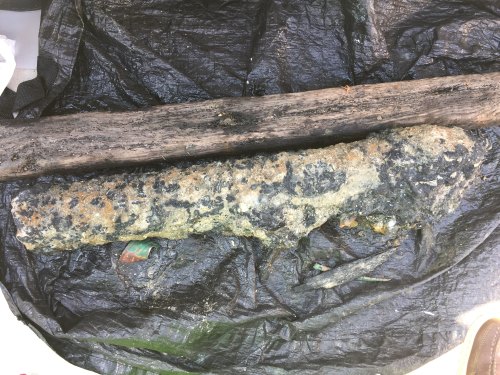
Object type: TIMBER
Broad period: POST MEDIEVAL
County: Dorset
Workflow stage: Published
Find consists of two sections of timber or wood. The first measures approximately 1650 mm in length, 85 mm in width and 90 mm in depth. There are no diagnostic elements visible upon the timber, such as tool marks or fixing points, and therefore its function remains unknown. It does, however, appear to be faced and is therefore unlikely to be a piece of natural driftwood.
The second piece of wood measures approximately 196 mm in length and 20 mm in width. There is at least one possible nail hole visible and again it appears to have been faced or worked by human hands. It is heavily deg…
Created on: Friday 1st June 2018
Last updated: Thursday 26th March 2020
Spatial data recorded.
Record ID: MAS-D100197
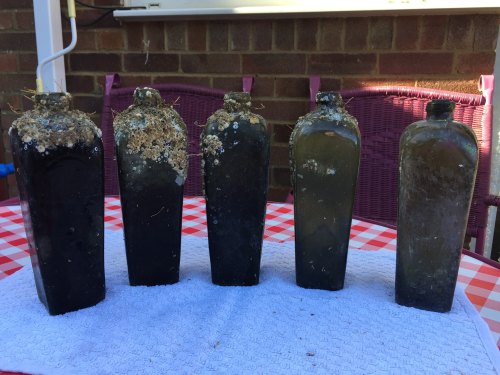
Object type: BOTTLE
Broad period: POST MEDIEVAL
County: Kent
Workflow stage: Published
Six glass gin bottles. 'Case gin' or 'taper gin' bottles have a square cross section that means that packing became more effective than with round bottles. The bodies taper wider towards a sharp shoulder, short neck and a champagne finish. The bottles are olive green in colour, and are in a fair condition despite encrusting towards the neck. This shape and style of bottle originated in and was commonly made in Europe at least as early as the mid-17th century. These examples do not exhibit the bevelled corners generally seen on bottles of the 1860s or later and may therefore be earlier …
Created on: Wednesday 4th July 2018
Last updated: Thursday 26th March 2020
Spatial data recorded.
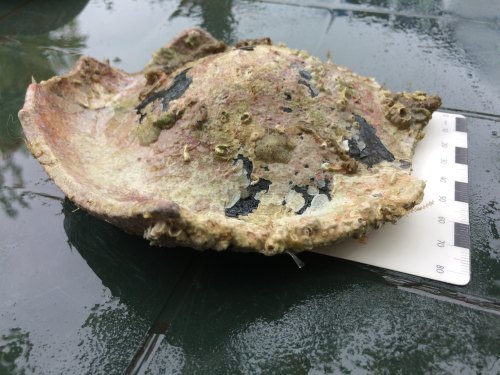
Record ID: MAS-D100045
Object type: BOTTLE
Broad period: POST MEDIEVAL
County: Dorset
Workflow stage: Published
Base of a broken glass onion bottle found loose on the seabed with quite a lot of marine growth present, including over the broken edges. Found on Marl Beds - not long after passing over an area of numerous fairly amorphous concretions apparently loose on the coarse sandy seabed.
Created on: Tuesday 30th May 2017
Last updated: Friday 28th February 2020
Spatial data recorded.
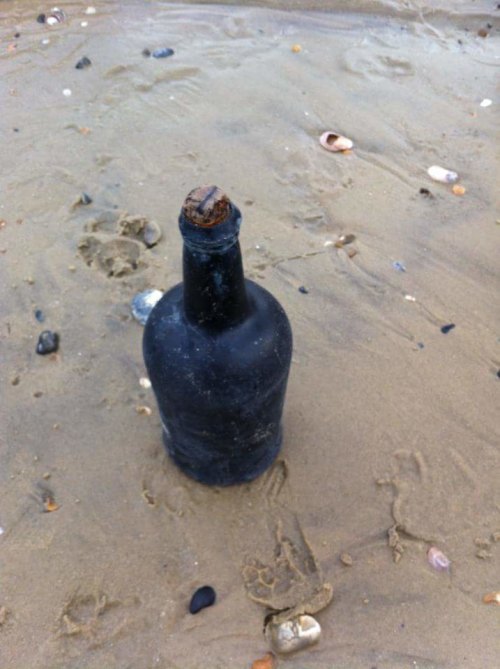
Record ID: MAS-O100028
Object type: BOTTLE
Broad period: POST MEDIEVAL
County: Isle of Wight
Workflow stage: Published
A bottle made from dark green/black glass, bearing a protruding cork. It has a slightly concave body, flaring moderately at the base, leading to gently rounded shoulders with clear definition where they intersect with the neck. The neck itself is broadly straight, tapering slightly where it meets the finish. The finish is of either a double oil or brandy type. The bottle is reminiscent of a spirit bottle of the squat cylinder style, though vessels of this style were used to contain a variety of products beyond beers, wines and spirits. Bottles of this type were manufactured from at lea…
Created on: Saturday 25th February 2017
Last updated: Friday 21st February 2020
Spatial data recorded.

Record ID: MAS-100004
Object type: CLAY PIPE (SMOKING)
Broad period: POST MEDIEVAL
County: Kent
Workflow stage: Published
All three white pipes here are complete, and are of the short or 'cutty' form. Two carry relief moulded decoration featuring Masonic emblems (incorporating the crossed compass and square), while the third is in the form of a male head, wearing a thin-brimmed cap, possibly a military figure. Pipes with Masonic emblems were made from the mid-18th century in the UK, but remained popular into the early 20th century, while the male head falls into a group of more elaborate decorative pipes with bowls moulded in the form of human heads and animals, common in the late 19th and early 20th cent…
Created on: Thursday 28th July 2016
Last updated: Tuesday 29th January 2019
Spatial data recorded.
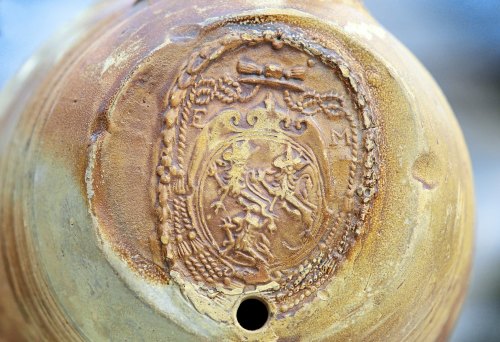
Record ID: MAS-100018
Object type: COSTREL
Broad period: POST MEDIEVAL
Workflow stage: Published
A salt-glazed stoneware barrel costrel, almost certainly German and probably dating to the 17th century. Recovered in 1966 during a dive at a depth of approximately 50-60 ft, and found in association with two lots of cannon, cannonballs and lead sheeting.
Created on: Friday 21st October 2016
Last updated: Wednesday 23rd May 2018
No spatial data available.
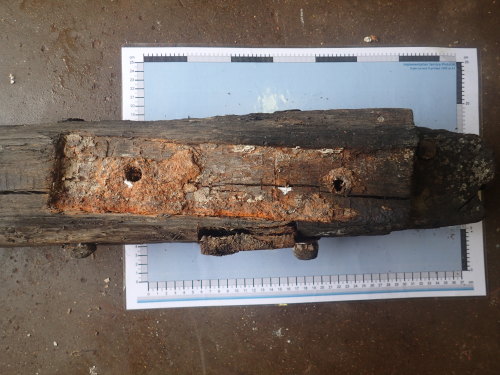
Record ID: MAS-F100107
Object type: TRANSPORT
Broad period: POST MEDIEVAL
County: East Sussex
Workflow stage: Published
This ship's timber is 830 mm long, 110 x 120 mm in profile, with truncated 25 mm diameter treenails; and a 385 x 65 mm slot for the supporting metal work from which the visible corrosion products suggest that they were of iron construction. The images were forwarded to ship expert and author Richard Endsor.
The timber appears to be the beam end from a small ship, with evidence of knees on both sides. The small piece of plank let into it crossways may be the remains of a waterway at the side making this face the upper side of the beam. The treenails probably secured the plank. The notc…
Created on: Wednesday 23rd August 2017
Last updated: Wednesday 23rd May 2018
Spatial data recorded.
Record ID: MAS-O100026
Object type: SHIPS TIMBER
Broad period: NINETEENTH CENTURY
County: North Yorkshire
Workflow stage: Published
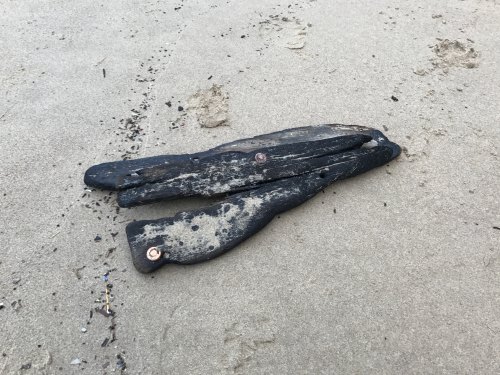
Two fragments of waterlogged wood with two copper fasteners dating from the post-medieval period onwards.
The wood may be the remains of two planks of wood used in the construction of a ship as the planks are secured with one copper fastening and a hole is visible where another fastening may have also been used. Copper rivets are the standard method of fastening the planks to each other in clinker constructed vessels, or in the planks to the ribs or frames (Traditional Maritime Skills website, accessed September 2017). Clinker is a method of constructing the hull of a boat by fixing w…
Created on: Saturday 28th January 2017
Last updated: Tuesday 22nd May 2018
Spatial data recorded.
Record ID: MAS-F100110
Object type: POST
Broad period: POST MEDIEVAL
County: East Sussex
Workflow stage: Published
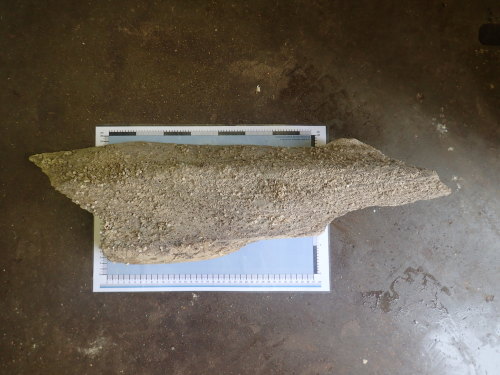
Heavily eroded and abraded timber fragment with marine borer and growth present. As it is so worn, it is difficult to tell what type of wood it is and whether this fragment was originally completely shaped and worked, or just partially worked to achieve its function. The timber does not exhibit any evidence or staining from fastenings, however, there is one hole that could have been a fastening point at some stage.
It is thought that this fragment may be a broken post or groyne timber that has come from a beach rather than material relating to a wreck. Groynes are wooden barriers bui…
Created on: Wednesday 23rd August 2017
Last updated: Tuesday 8th May 2018
Spatial data recorded.
Records per page: 10 20 40 100
Sort your search by:
Which direction?
Total results available: 33
Search server index: valhalla
You are viewing records: 11 - 20.
Search statistics
- Total quantity: 112
- Mean quantity: 3.394
- Maximum: 26
Filter your search
Object type
All Object type optionsCounty of origin
Broad period
Institution
Material
All Material optionsWorkflow

About us
About our site

Data labs
Find us
Wessex Archaeology
Portway House, Old Sarum Park
Salisbury SP4 6EB
T: +44(0) 1722 326867
E: