
Database search results
Back to simple search | Back to advanced search
- Preservation: Fair
- Workflow: Record published
- Show this many records per page: 10
- Page: 2
- Direction: asc
You searched for:
Record ID: MAS-D100065
Object type: BOTTLE
Broad period: NINETEENTH CENTURY
County: Kent
Workflow stage: Published 
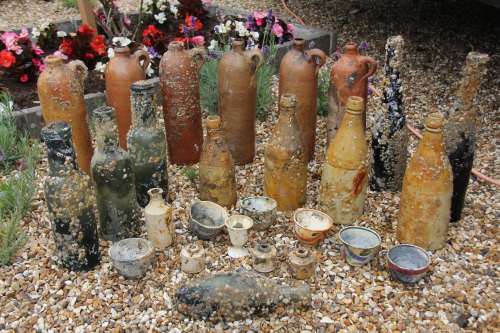
Six stoneware seltzer bottles, of a type used to carry mineral water from various Continental (mainly German) spas. The term 'seltzer' takes its name from the town of Selters in the lower Rhineland, one of the original producers of effervescent mineral waters. This cylindrical bottle type was used from the early 19th century through to the First World War. These types of bottles were produced by the specialist potters known as Krugbacker, or pot bakers, in the Westerwald region of Germany. These bottles, which changed little throughout the 19th century, were slender and cylindrical and…
Created on: Monday 24th July 2017
Last updated: Thursday 5th October 2017
Spatial data recorded.
Record ID: MAS-D100100
Object type: BOTTLE
Broad period: NINETEENTH CENTURY
County: Kent
Workflow stage: Published
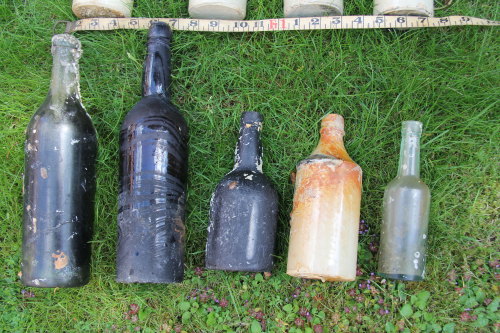
A collection of five bottles comprising two full-size glass bottles, one squat cylindrical glass bottle, one small clear bottle, and one stoneware bottle. All the bottles are believed to be of nineteenth and twentieth century type, although it is difficult to date all but the stoneware bottle.
The two full-size glass bottles are thought to be either wine or beer bottles. If the bottles have kicked bases, it would indicate a wine bottle, while a flat base would indicate a beer bottle.
The squat cylindrical glass bottle was thought to be a port bottle, however if the base is flat, thi…
Created on: Friday 11th August 2017
Last updated: Tuesday 22nd May 2018
Spatial data recorded.
Record ID: MAS-D100087
Object type: DOMED LID
Broad period: NINETEENTH CENTURY
County: Kent
Workflow stage: Published
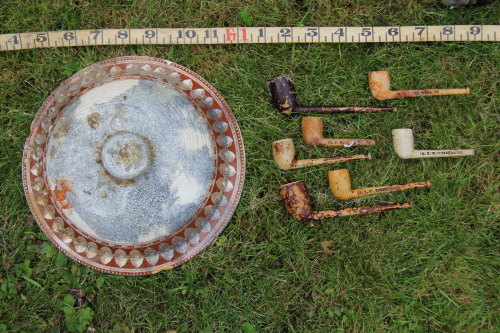
One ceramic serving dish lid made of a refined whiteware with transfer-printed design in red.The term 'whiteware' is used in historical archaeology to denote refined ceramics with a whiter and denser body than pearlware that generally postdates c. 1830. Whiteware is a class of ceramic products that include porcelain and china. They are usually, but not necessarily white and consist typically of clays, feldspar, potter's flint, and whiting (calcium carbonate).
Created on: Friday 11th August 2017
Last updated: Wednesday 6th December 2017
Spatial data recorded.
Record ID: MAS-D100084
Object type: BOTTLE
Broad period: NINETEENTH CENTURY
County: Kent
Workflow stage: Published
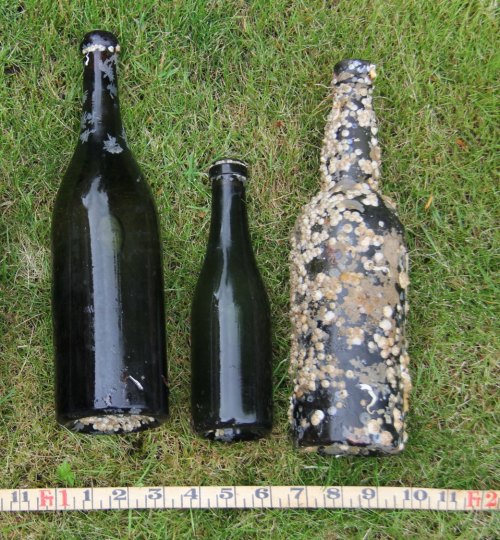
Three cylindrical glass bottles. The two larger bottles are full size wine bottles. One is of the 'Burgundy' type and is most likely Continental. The half-size wine bottle, originally thought to be a champagne bottle, also has a Continental style neck. The Continental style neck appears around the middle of the 19th century (Dumbrell 1983). All are of nineteenth or twentieth century type.
Created on: Friday 11th August 2017
Last updated: Wednesday 6th December 2017
Spatial data recorded.
Record ID: MAS-F100103
Object type: BOTTLE
Broad period: MODERN
County: East Sussex
Workflow stage: Published
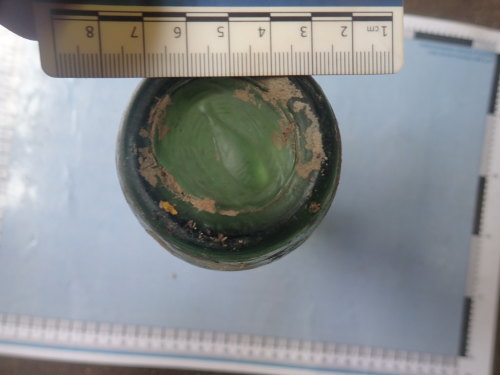
This flat-based Hamilton, or 'torpedo' bottle stands 240 mm high, with a 64-mm wide base and is approximately 90 mm wide at the waist. It has a 'bottle logo' embossed on its base. There are possibly other text/numerals that have since worn away. The bottle shows moulding scars on the base and sides. It has a crown top finish.
The egg-shaped bottle was first patented by William Francis Hamilton in 1814, the idea being that the bottle had to be stored on its side to keep the cork wet and ensuring a good seal on the reusable bottle. In around 1870, the flat based egg or Hamilton bottle w…
Created on: Wednesday 23rd August 2017
Last updated: Wednesday 23rd May 2018
Spatial data recorded.
Record ID: MAS-F100104
Object type: SHELL CASES
Broad period: MODERN
County: East Sussex
Workflow stage: Published
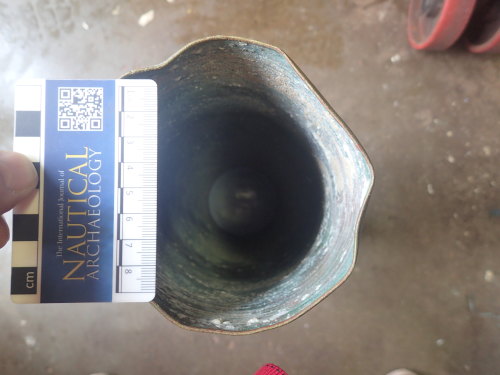
The shell case measures 660 mm long and is 152 mm in diameter at the base, and 116 mm in diameter at the neck though this has been buckled and stretched. The shell case appears to have been either constructed without a base, or it has been removed at some point in the past. The diameter of the neck and its overall size point to it being a 4.5-inch or possibly a 4.7-inch shell case. Without the base with the details of type, manufacturer and date of manufacture, the history and origin of this case is not clear. It would have been part of a fixed round, i.e. the shell was attached to the…
Created on: Wednesday 23rd August 2017
Last updated: Tuesday 8th May 2018
Spatial data recorded.
Record ID: MAS-D100133
Object type: BOTTLES
Broad period: POST MEDIEVAL
Workflow stage: Published
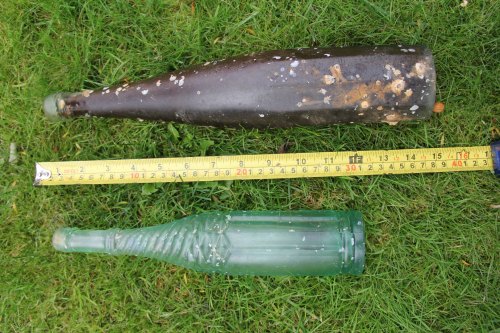
Two clear glass fruit bottles, one ornate green glass wine bottle, one tall brown wine bottle with glass hexagonal base (94 stamped on base) and one black glass bottle.
The fruit bottles are 280 mm long and 70 mm wide. One appears to be more encrusted and discoloured than the other, but both are consistent in their shape. They possess straight bodies, abrubtly curving shoulders and straight necks running to applied finishes. One is still stoppered and contains what appears to be olives. Both are indicative of fruit bottles in style and shape.
The two wine bottles differ in appearance…
Created on: Monday 23rd October 2017
Last updated: Friday 27th March 2020
No spatial data available.
Record ID: MAS-D100134
Object type: HANDLE
Broad period: POST MEDIEVAL
Workflow stage: Published
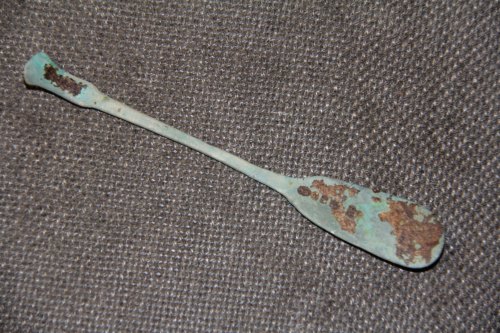
The stem of a silver fork or spoon with a hallmark pattern.
The set of four hallmarks located together on the piece of cutlery indicates it was made later than 1781, when this practice was first introduced. Based on this image, this type of spoon/fork is possibly a Fiddle pattern - this refers to the shape of the handle - and is a type introduced in the 1780s and still in production today. The Fiddle pattern means that there are shoulders on the stem near the bowl, which is seen on this example. The lower end of the stem juts out around 90 degrees but this example may have been worn d…
Created on: Monday 23rd October 2017
Last updated: Monday 30th March 2020
No spatial data available.
Record ID: MAS-D100138
Object type: CONTAINERS
Broad period: NINETEENTH CENTURY
County: Kent
Workflow stage: Published
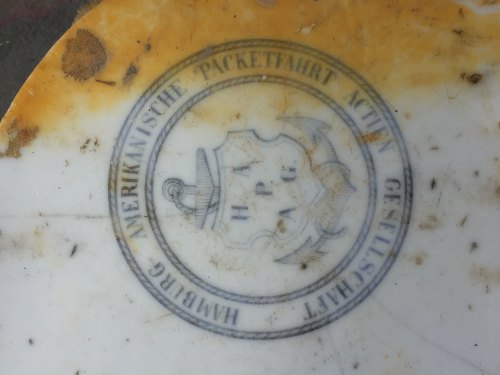
Two shards of crockery with makers mark present. The stamp is made up of letters "H A P A G" and a stylised admiralty anchor which has a wooden stock behind a shield. "H.A.P. A.G" refers to The Hamburg Amerikanische Packetfahrt Aktien Gesellschaft; a German shipping company that operated from 1847 until 1970. The stamps would have been on the base of the corckery therefore it is not clear whether these pieces would have belonged to bowls or plates when they were in use. The shards are white, with dark flecked inclusions and yellowish patches. It is more than likely that these pieces we…
Created on: Wednesday 2nd May 2018
Last updated: Thursday 26th March 2020
Spatial data recorded.
Record ID: MAS-D100146
Object type: UNIDENTIFIED OBJECT
Broad period: NINETEENTH CENTURY
County: Kent
Workflow stage: Published
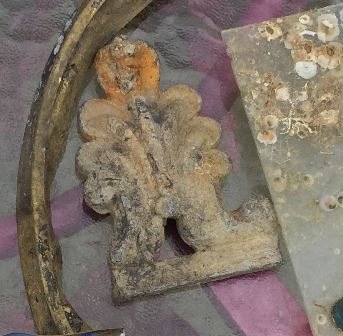
Find consists of an ornate metal piece, bearing a flyr de lys type of design above a solid bar, presumably used for mounting. No dimensions were given, though it is suggested to be made from lead and H shaped, the finder described it as "part of a fireguard from the ship room". This material type would seem unsuitable for such a purpose, therefore it is still unclear what the purpose of this object is, although it is generally accepted that it is a decorative object of some sort.
Created on: Wednesday 2nd May 2018
Last updated: Thursday 26th March 2020
Spatial data recorded.
Records per page: 10 20 40 100
Sort your search by:
Which direction?
Total results available: 27
Search server index: objects
You are viewing records: 11 - 20.
Search statistics
- Total quantity: 98
- Mean quantity: 3.630
- Maximum: 26
Filter your search
Object type
All Object type optionsCounty of origin
Broad period
Institution
Material
All Material optionsWorkflow
11 - 20 of 27 records.

About us
About our site

Data labs
Find us
Wessex Archaeology
Portway House, Old Sarum Park
Salisbury SP4 6EB
T: +44(0) 1722 326867
E: