
Database search results
Back to simple search | Back to advanced search
- Discovery: Diving
- Page: 2
- Show this many records per page: 10
- Sort: updated
You searched for:
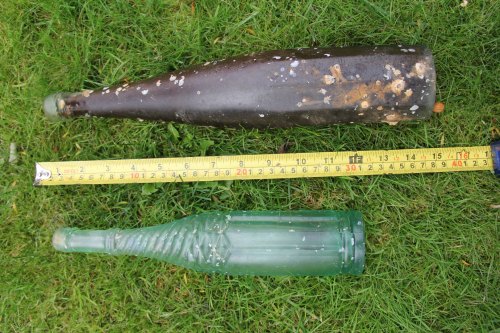
Record ID: MAS-D100133
Object type: BOTTLES
Broad period: POST MEDIEVAL
Workflow stage: Published 
Two clear glass fruit bottles, one ornate green glass wine bottle, one tall brown wine bottle with glass hexagonal base (94 stamped on base) and one black glass bottle.
The fruit bottles are 280 mm long and 70 mm wide. One appears to be more encrusted and discoloured than the other, but both are consistent in their shape. They possess straight bodies, abrubtly curving shoulders and straight necks running to applied finishes. One is still stoppered and contains what appears to be olives. Both are indicative of fruit bottles in style and shape.
The two wine bottles differ in appearance…
Created on: Monday 23rd October 2017
Last updated: Friday 27th March 2020
No spatial data available.
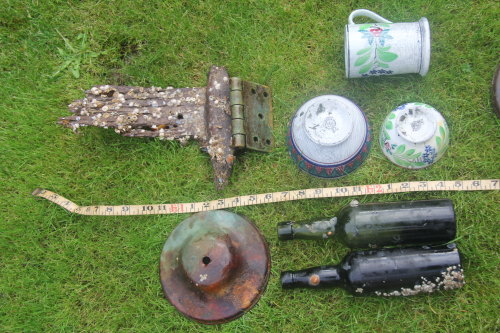
Record ID: MAS-D100129
Object type: BOTTLES
Broad period: POST MEDIEVAL
Workflow stage: Published
Two bottles with dark glass. Both appear to be 250 mm from finish to base and 50 mm in diameter. One bottle is dark green and the other black. Both have been encrusted and marked with biological activity, which could be mistaken for ornate symbols and badges. Neither are corked or stoppered. Both are very similar in style with straight bodies, rounded and slightly abrupt shoulders that lead into slightly bulging necks before an applied wine finish. From this shape and size, both bottles are assumed to be wine bottles, or perhaps liquor bottles from the 19-20th century.
The finish of …
Created on: Monday 9th October 2017
Last updated: Friday 27th March 2020
No spatial data available.
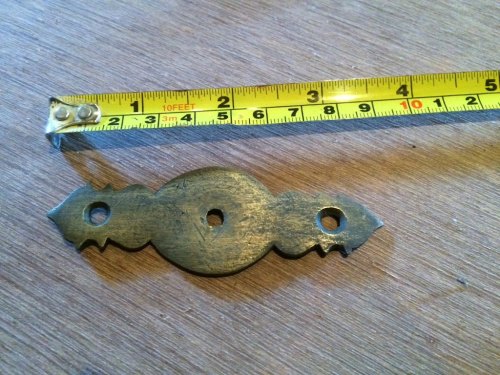
Record ID: MAS-O100124
Object type: BRASS
Broad period: POST MEDIEVAL
Workflow stage: Published
One ornate brass piece. The piece has an aperture in the middle, in the centre of a circular disc which is itself recessed slightly into the surface. The disc extends laterally into two leaf-shaped limbs, which are decoratively styled and form curved arrows at their tips. At the end of each limb there is a circular hole, which was likely used to fasten the brass piece to its host object. These holes are countersunk, presumably to accommodate the heads of screws. The piece is approximately 90 mm in length, with a width of 40 mm and thickness of 2 mm. The diameter of the two larger holes…
Created on: Monday 11th September 2017
Last updated: Friday 27th March 2020
Spatial data recorded.
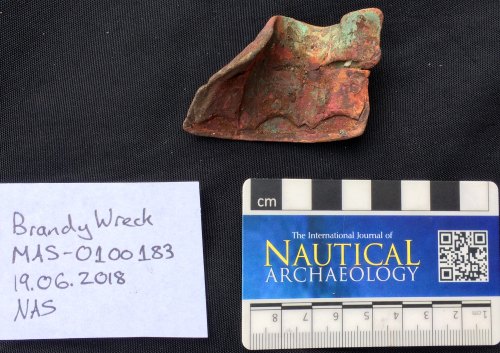
Record ID: MAS-D100184
Object type: UNIDENTIFIED OBJECT
Broad period: POST MEDIEVAL
County: Dorset
Workflow stage: Published
A single piece of copper alloy sheeting, measuring approximately 70 mm by 55 mm with a thickness of c. 2 mm. The item bears 4 grooves pressed into the metal along the long axis on one face, only one of which is evident on the opposite face. The item appears to be distorted from its original shape, all the edges appear intact suggesting it is otherwise complete. The function of such an item is unclear, though it was recovered in close proximity to a swivel gun (MAS-D100180) and may relate to the functioning of such a weapon in some way.
Created on: Friday 1st June 2018
Last updated: Thursday 26th March 2020
Spatial data recorded.
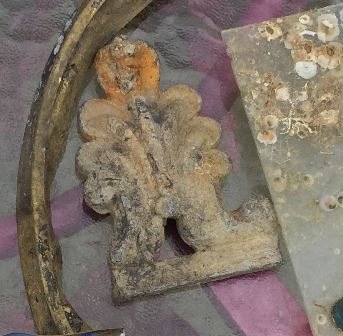
Record ID: MAS-D100146
Object type: UNIDENTIFIED OBJECT
Broad period: NINETEENTH CENTURY
County: Kent
Workflow stage: Published
Find consists of an ornate metal piece, bearing a flyr de lys type of design above a solid bar, presumably used for mounting. No dimensions were given, though it is suggested to be made from lead and H shaped, the finder described it as "part of a fireguard from the ship room". This material type would seem unsuitable for such a purpose, therefore it is still unclear what the purpose of this object is, although it is generally accepted that it is a decorative object of some sort.
Created on: Wednesday 2nd May 2018
Last updated: Thursday 26th March 2020
Spatial data recorded.
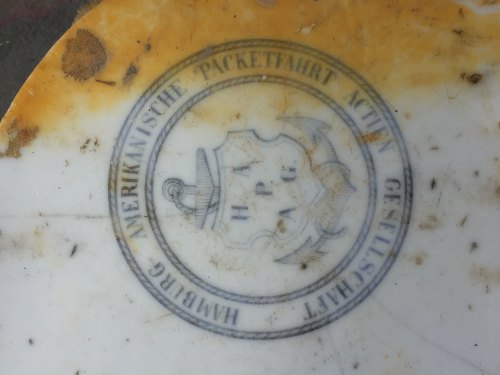
Record ID: MAS-D100138
Object type: CONTAINERS
Broad period: NINETEENTH CENTURY
County: Kent
Workflow stage: Published
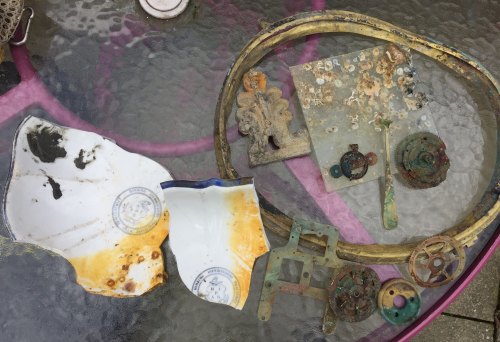
Two shards of crockery with makers mark present. The stamp is made up of letters "H A P A G" and a stylised admiralty anchor which has a wooden stock behind a shield. "H.A.P. A.G" refers to The Hamburg Amerikanische Packetfahrt Aktien Gesellschaft; a German shipping company that operated from 1847 until 1970. The stamps would have been on the base of the corckery therefore it is not clear whether these pieces would have belonged to bowls or plates when they were in use. The shards are white, with dark flecked inclusions and yellowish patches. It is more than likely that these pieces we…
Created on: Wednesday 2nd May 2018
Last updated: Thursday 26th March 2020
Spatial data recorded.
Record ID: MAS-D100174
Object type: CUTLERY
Broad period: NINETEENTH CENTURY
County: Kent
Workflow stage: Published
This record refers to the handle of a metal spoon or fork included within this group of finds. The diagnostic end of the piece is broken and therefore is uncertain whether this is a fork or spoon, and a lack of measurements precludes determining whether this is a tea or desert size in terms of spoon , or cake or main course size of fork. The fabric of the item, though slightly coroded, has a yellowish colour which may indicate gold or gold plating has been used in its manufacture. Alternatively, given the verdigris colour of the corrosion, may have been constructed in a copper alloy or…
Created on: Wednesday 2nd May 2018
Last updated: Thursday 26th March 2020
Spatial data recorded.
Record ID: MAS-O100179
Object type: ORDNANCE
Broad period: POST MEDIEVAL
County: Dorset
Workflow stage: Published
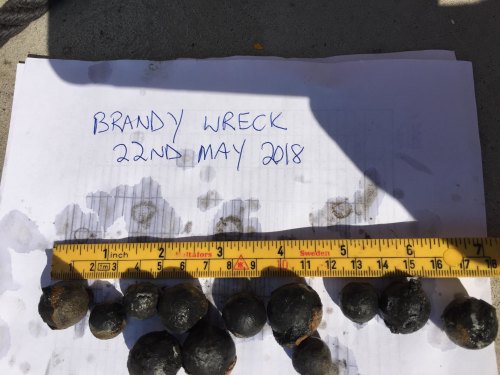
This find consists of 12 lead balls varying in diameter between c. 15 mm and 21mm. All appear unfired and bear the mould lines and sprue marks from being hand moulded in a 2 part mould. The balls themselves are in fair condition, though some bear concretion/encrustation.
Images of the finds were sent to Charles Trollop, an expert in historical ordnance, who advised that in all likelihood these are English Standard Musket (0.775 " or 19.79 mm) and Carbine (0.615 " or 15.64 mm) Balls. These standards relate to most of the black powder/smooth bore period from the 17th to 19th centuries.
Created on: Friday 1st June 2018
Last updated: Thursday 26th March 2020
Spatial data recorded.
Record ID: MAS-D100178
Object type: TOOTHBRUSH
Broad period: POST MEDIEVAL
County: Dorset
Workflow stage: Published
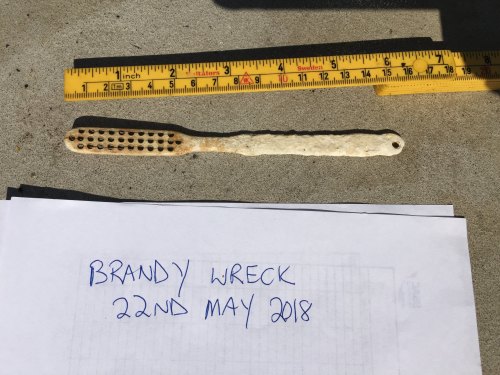
This find consists of a brush handle and head manufactured from either bone, horn or ivory, with the bristles missing. The item is approximately 160 mm in overall length, with the head being c. 60 mm, a neck of c. 20 mm and a handle of 80 mm. The head of the brush is c. 15 mm wide, the neck c. 8mm and the handle c.10 mm. There is a small hole in the end of the handle, presumably for accomodating a lanyard or for hanging the brush from. In the head there are 32 holes for accomodating the bristles, with channels recessed and filled on the rear face where the bristles would have been secu…
Created on: Friday 1st June 2018
Last updated: Thursday 26th March 2020
Spatial data recorded.
Record ID: MAS-D100177
Object type: TIMBER
Broad period: POST MEDIEVAL
County: Dorset
Workflow stage: Published
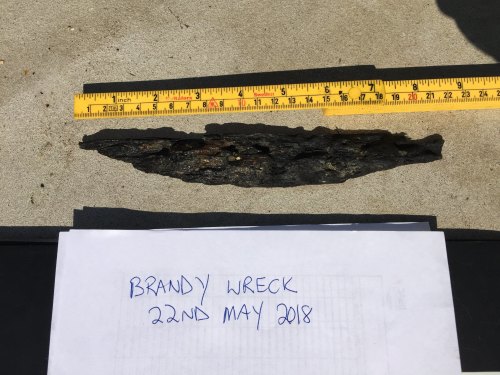
Section of highly degraded timber measuring approximately 216 mm in length by 31 mm at its widest point. The ends taper to a point, in a regular fashion that seems a deliberate aspect of the timber rather than part of the process of degredation. At least five nail or bolt holes are apparent in the face of the timber, further differentiating the piece from a section of unworked natural wood. The function of the timber is unidentifiable from the data available. As it has been recovered from a wreck it is likely to relate to the vessel itself and can tentatively be interpreted as a ships …
Created on: Friday 1st June 2018
Last updated: Thursday 26th March 2020
Spatial data recorded.
Records per page: 10 20 40 100
Sort your search by:
Which direction?
Total results available: 80
Search server index: objects
You are viewing records: 11 - 20.
Search statistics
- Total quantity: 222
- Mean quantity: 2.775
- Maximum: 26
Filter your search
Object type
All Object type optionsCounty of origin
Broad period
Institution
Material
All Material optionsWorkflow

About us
About our site

Data labs
Find us
Wessex Archaeology
Portway House, Old Sarum Park
Salisbury SP4 6EB
T: +44(0) 1722 326867
E: