
Database search results
Back to simple search | Back to advanced search
- Period to: MODERN
- Sort: institution
- Show this many records per page: 10
- Page: 3
You searched for:
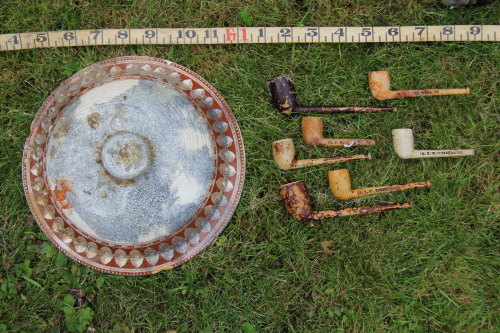
Record ID: MAS-D100087
Object type: DOMED LID
Broad period: NINETEENTH CENTURY
County: Kent
Workflow stage: Published 
One ceramic serving dish lid made of a refined whiteware with transfer-printed design in red.The term 'whiteware' is used in historical archaeology to denote refined ceramics with a whiter and denser body than pearlware that generally postdates c. 1830. Whiteware is a class of ceramic products that include porcelain and china. They are usually, but not necessarily white and consist typically of clays, feldspar, potter's flint, and whiting (calcium carbonate).
Created on: Friday 11th August 2017
Last updated: Wednesday 6th December 2017
Spatial data recorded.
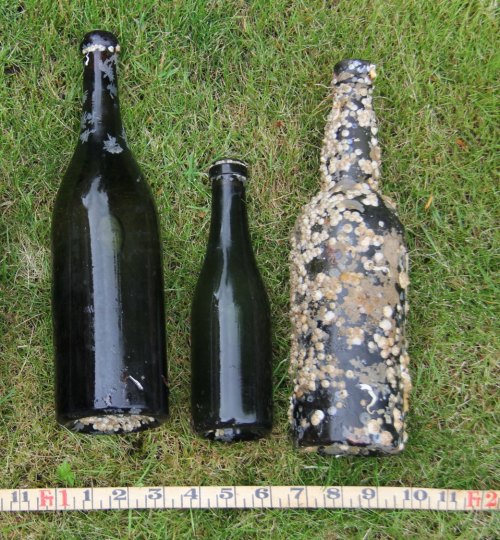
Record ID: MAS-D100084
Object type: BOTTLE
Broad period: NINETEENTH CENTURY
County: Kent
Workflow stage: Published
Three cylindrical glass bottles. The two larger bottles are full size wine bottles. One is of the 'Burgundy' type and is most likely Continental. The half-size wine bottle, originally thought to be a champagne bottle, also has a Continental style neck. The Continental style neck appears around the middle of the 19th century (Dumbrell 1983). All are of nineteenth or twentieth century type.
Created on: Friday 11th August 2017
Last updated: Wednesday 6th December 2017
Spatial data recorded.
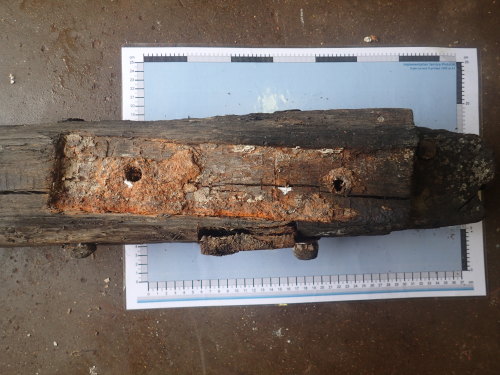
Record ID: MAS-F100107
Object type: TRANSPORT
Broad period: POST MEDIEVAL
County: East Sussex
Workflow stage: Published
This ship's timber is 830 mm long, 110 x 120 mm in profile, with truncated 25 mm diameter treenails; and a 385 x 65 mm slot for the supporting metal work from which the visible corrosion products suggest that they were of iron construction. The images were forwarded to ship expert and author Richard Endsor.
The timber appears to be the beam end from a small ship, with evidence of knees on both sides. The small piece of plank let into it crossways may be the remains of a waterway at the side making this face the upper side of the beam. The treenails probably secured the plank. The notc…
Created on: Wednesday 23rd August 2017
Last updated: Wednesday 23rd May 2018
Spatial data recorded.
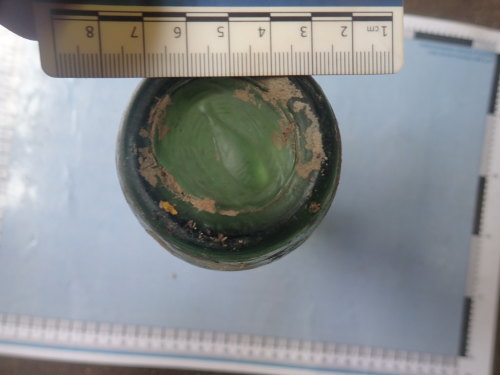
Record ID: MAS-F100103
Object type: BOTTLE
Broad period: MODERN
County: East Sussex
Workflow stage: Published
This flat-based Hamilton, or 'torpedo' bottle stands 240 mm high, with a 64-mm wide base and is approximately 90 mm wide at the waist. It has a 'bottle logo' embossed on its base. There are possibly other text/numerals that have since worn away. The bottle shows moulding scars on the base and sides. It has a crown top finish.
The egg-shaped bottle was first patented by William Francis Hamilton in 1814, the idea being that the bottle had to be stored on its side to keep the cork wet and ensuring a good seal on the reusable bottle. In around 1870, the flat based egg or Hamilton bottle w…
Created on: Wednesday 23rd August 2017
Last updated: Wednesday 23rd May 2018
Spatial data recorded.
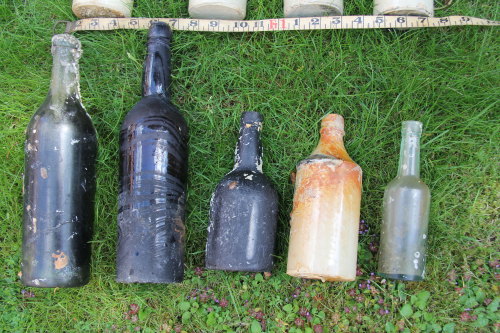
Record ID: MAS-D100100
Object type: BOTTLE
Broad period: NINETEENTH CENTURY
County: Kent
Workflow stage: Published
A collection of five bottles comprising two full-size glass bottles, one squat cylindrical glass bottle, one small clear bottle, and one stoneware bottle. All the bottles are believed to be of nineteenth and twentieth century type, although it is difficult to date all but the stoneware bottle.
The two full-size glass bottles are thought to be either wine or beer bottles. If the bottles have kicked bases, it would indicate a wine bottle, while a flat base would indicate a beer bottle.
The squat cylindrical glass bottle was thought to be a port bottle, however if the base is flat, thi…
Created on: Friday 11th August 2017
Last updated: Tuesday 22nd May 2018
Spatial data recorded.
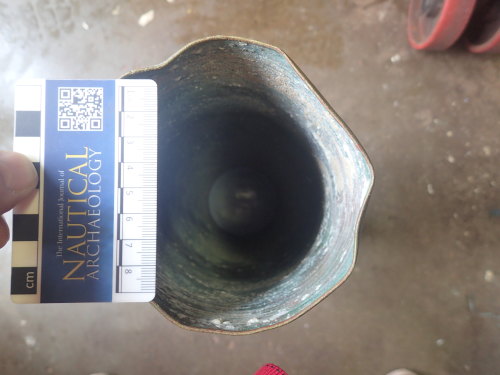
Record ID: MAS-F100104
Object type: SHELL CASES
Broad period: MODERN
County: East Sussex
Workflow stage: Published
The shell case measures 660 mm long and is 152 mm in diameter at the base, and 116 mm in diameter at the neck though this has been buckled and stretched. The shell case appears to have been either constructed without a base, or it has been removed at some point in the past. The diameter of the neck and its overall size point to it being a 4.5-inch or possibly a 4.7-inch shell case. Without the base with the details of type, manufacturer and date of manufacture, the history and origin of this case is not clear. It would have been part of a fixed round, i.e. the shell was attached to the…
Created on: Wednesday 23rd August 2017
Last updated: Tuesday 8th May 2018
Spatial data recorded.
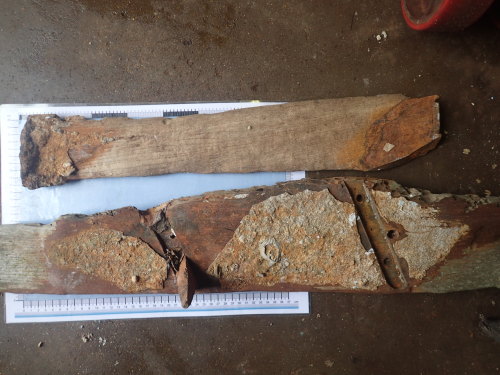
Record ID: MAS-F100106
Object type: LADDER
Broad period: NINETEENTH CENTURY
County: East Sussex
Workflow stage: Published
These two timbers are two components of a companion ladder. The larger piece measures 1.14 m long by 0.15 m wide and based on the visible ridges to accommodate the stairs, would have been the left-hand side banister of the ladder. The smaller piece measures 0.56 m wide and is 20 mm thick. This piece is one of the stairs that would have fitted between both banisters and still slots in to one of the grooves on the remaining banister. The join is step and groove radiused rather than square cut.
Companion ladders or a companion way is usually steep but has treads or stairs rather than run…
Created on: Wednesday 23rd August 2017
Last updated: Tuesday 8th May 2018
Spatial data recorded.

Record ID: MAS-F100105
Object type: STRUCTURAL TIMBER
Broad period: NINETEENTH CENTURY
County: East Sussex
Workflow stage: Published
These two unidentified timbers measure 790 x 75 x 90 mm and 160 x 100 x 60 mm and were recovered from a boat's trawl nets whilst working out of Newhaven, East Sussex. The small piece shows evidence of a longer period of immersion in terms of abrasion and marine borer damage, though this may also be due to the relative hardness and variety of the two woods, or any treatment that might have been received to protect the timber. Neither timber appears to be of ship related origin, with the larger darker piece looking as if it might have been a post and rail fence board originally, rather t…
Created on: Wednesday 23rd August 2017
Last updated: Tuesday 22nd May 2018
Spatial data recorded.
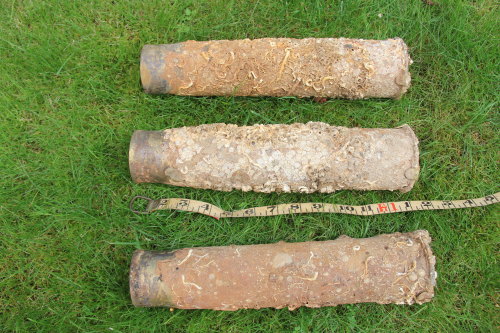
Record ID: MAS-D100115
Object type: CARTRIDGE
Broad period: NINETEENTH CENTURY
County: Kent
Workflow stage: Published
Images of this find were sent to Trevor Parker of the Ordnance Society. He confirmed that these three shell cases belong to a six-pounder Hotchkiss gun. This particular type of gun was introduced in 1884 for use against torpedo boats. They were used during First World War on the Arethusa and early 'C' class cruisers and a few submarines as well as on Monitors M.15 through M.33. Originally French in origin, they were introduced to Britain in 1886 (Tucker 2013). Many were subsequently used as sub-calibre and saluting guns which meant that they were still available in 1939 (Naval Weapons,…
Created on: Friday 8th September 2017
Last updated: Thursday 5th October 2017
Spatial data recorded.
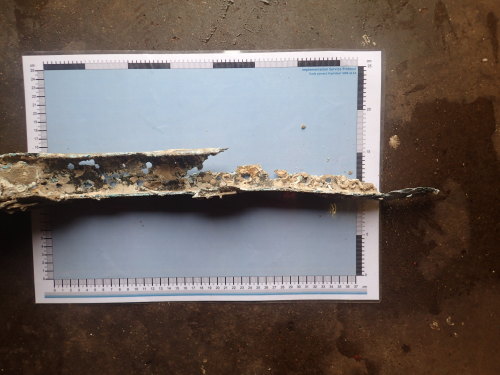
Record ID: MAS-F100111
Object type: AIRCRAFT COMPONENT
Broad period: MODERN
County: East Sussex
Workflow stage: Published
Aluminium aircraft section, heavily corroded and damaged. No identifying marks or plates visible, though two cross member plate remnants present. 870 x 45mm.
The lack of identifying marks means that the type and origin of the aircraft cannot be definitively identified from this recovered section. Initially thought to be part of a piston engine support frame from something like a Spitfire fighter, a Dakota transport aircraft, or perhaps one of the multi-engined bombers,this theory was discarded as these are generally circular in section. The double row of rivet holes down one side (pre…
Created on: Wednesday 23rd August 2017
Last updated: Wednesday 23rd May 2018
Spatial data recorded.
Records per page: 10 20 40 100
Sort your search by:
Which direction?
Total results available: 51
Search server index: valhalla
You are viewing records: 21 - 30.
Search statistics
- Total quantity: 140
- Mean quantity: 2.745
- Maximum: 26
Filter your search
Object type
All Object type optionsCounty of origin
All County of origin optionsBroad period
Institution
Material
All Material optionsWorkflow

About us
About our site

Data labs
Find us
Wessex Archaeology
Portway House, Old Sarum Park
Salisbury SP4 6EB
T: +44(0) 1722 326867
E: