
Database search results
Back to simple search | Back to advanced search
- Preservation: Poor
You searched for:
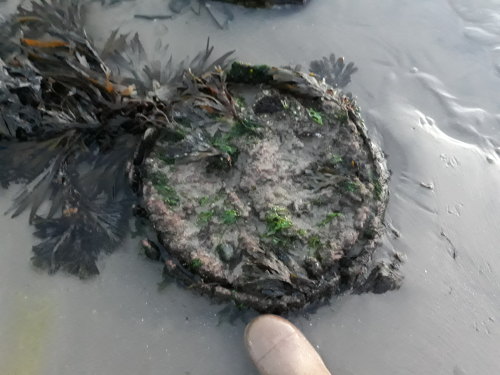
Record ID: MAS-O100234
Object type: BARREL
Broad period: POST MEDIEVAL
County: Down
Workflow stage: Published 
This find comprises of the remains of three to four wooden barrels, which were buried in the intertidal sandy substrate of a pleasure beach. The action of the tide revealed the barrels and it is unclear how much of the barrels remain. End of the staves, lengths of timber making the sides of the barrel, are visible and clearly degraded. In some cases these give the appearance of flaring outwards, implying that only the lower portion of the barrel remains. At least one barrel exhibits inwardly projecting staves, suggesting more than half of the barrel remains. There is some evidence for …
Created on: Monday 15th October 2018
Last updated: Monday 30th March 2020
Spatial data recorded.
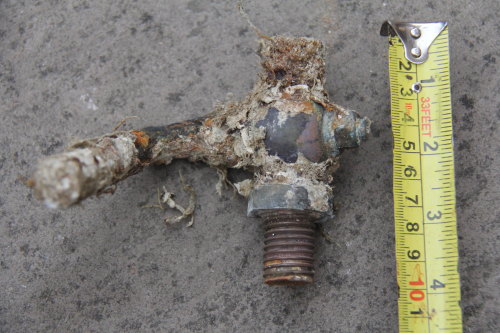
Record ID: MAS-D100228
Object type: VALVE
Broad period: NINETEENTH CENTURY
County: Kent
Workflow stage: Published
This copper alloy valve has a spherical central body with three sperate connections. One of the connections has a 25 mm long male thread evident, whilst the remaining two are concealed by concretion. One of the connections is probably a female thread entry and the third of the connections an elbow pipe union. The diameter of the connections is approximately 30 mm. Overall dimensions are approximately 100 mm by 100 mm.
The exact purpose of such a valve is not immediately apparent, though it likely relates to the vessels' operation and machinery rather than any cargo. As a coal powered …
Created on: Tuesday 25th September 2018
Last updated: Thursday 26th March 2020
Spatial data recorded.
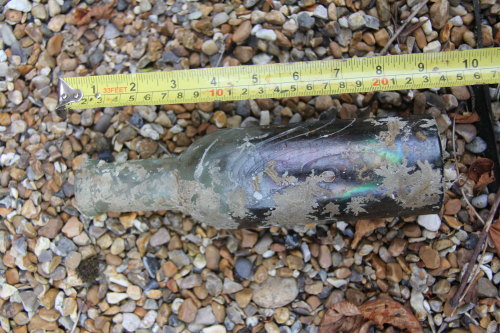
Record ID: MAS-D100227
Object type: BOTTLE
Broad period: NINETEENTH CENTURY
County: Kent
Workflow stage: Published
Bordeaux style bottle manufactured in clear aquamarine coloured glass, though weathering has caused the colours to distort and becom pearlescent towards the base of the vessel. It has a wide and straight neck and is finished in the applied ring or champagne style. The body is cylindrical, with low profile rounded shoulders. The height of the bottle is approximately 230 mm, the diameter of the body 60 mm and the neck 30 mm. Though this bottle is smaller than the more common 300 mm tall, 750 ml wine bottles it is most likely a wine bottle. It's clear colour suggests a dessert or sweet wi…
Created on: Tuesday 25th September 2018
Last updated: Thursday 26th March 2020
Spatial data recorded.
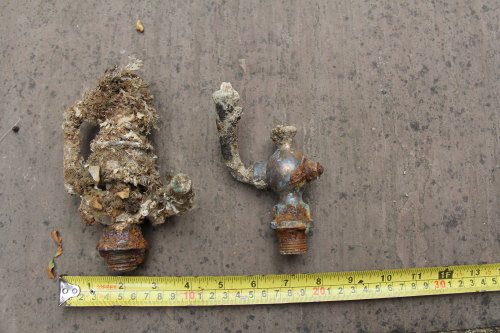
Record ID: MAS-D100220
Object type: VALVE
Broad period: MODERN
County: East Sussex
Workflow stage: Published
Two small brass valves and one small double valve. The first item has three conections, with two sections of thinner pipe (10 mm diameter approx) still attached perpendicular to threaded fixing, and both twisted. The thicker pipe (38 mm approx) runs parallel and opposite to threaded fixing. In all cases the rest of the pipes have sheared off. The second valve is similar in characteristics to the first, with three connections and a threaded fixing. This valve is slightly smaller and less encrusted, and only one section of thin (10 mm approx) pipe attached perpendicular to threaded fixin…
Created on: Friday 21st September 2018
Last updated: Thursday 26th March 2020
Spatial data recorded.
Record ID: MAS-D100219
Object type: VALVE
Broad period: MODERN
County: East Sussex
Workflow stage: Published
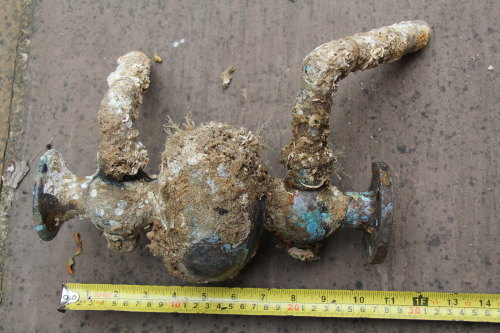
One small brass expansion valve. It is wheel operated from two opposite ends, roughly 260 mm apart. Approximately 50 mm in from each wheel there is a piped connection with the pipes roughly 25 mm diameter and both kinking into a right angle. Between the two wheels and the pipe connection, at the centre of the expansion valve, is a large metal boss, possibly where the two ends were fixed together. Item is heavily corroded and in poor condition.
Created on: Friday 21st September 2018
Last updated: Thursday 26th March 2020
Spatial data recorded.
Record ID: MAS-D100198
Object type: CUP
Broad period: NINETEENTH CENTURY
County: Kent
Workflow stage: Published
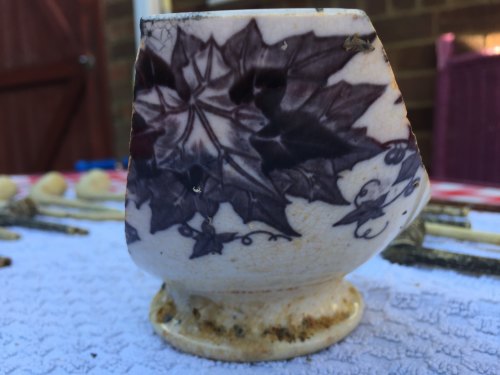
Find consists of a fragment of a porcelain cup, representing about 1/4 - 1/3 of the total vessel including a complete base bearing a backstamp of BRYONIA U & C. Though only partially surviving, what remains is in fair condition with evidence of slight encrustation around the base. No scale was provided, however, other examples of this pattern and manufacturer have a diameter of c. 75 mm. The U & C inscription refers to Utzschneider & Co, a company based originally in Sarreguemines, North East France. This region was previously part of Alsace-Lorraine and therefore the manuf…
Created on: Wednesday 4th July 2018
Last updated: Thursday 26th March 2020
Spatial data recorded.
Record ID: MAS-O100189
Object type: NAIL
Broad period: POST MEDIEVAL
County: Greater London Authority
Workflow stage: Published
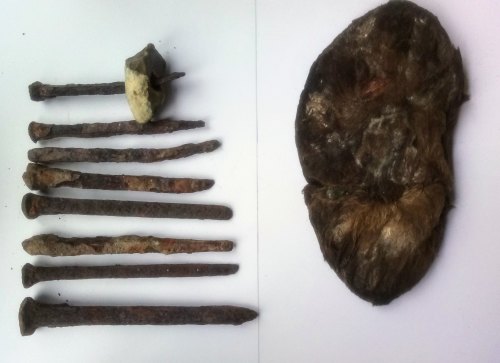
The find consists of 8 iron nails and an unidentifiable object that contains one further nail and is made of, or covered in, what appears to be fur.
The nails range in length from 135 - 175 mm, and c. 10 - 20 mm in width at their widest point below the head. All 8 nails have a rose type head and taper to a broad point. These features suggest that the nails were hand wrought, rather than cut or wire, a method where each nail is manufactured individually by hand on a blacksmiths anvil. The invention of the slitting mill c. 1590 simplified this process by manufacturing iron rods from whi…
Created on: Wednesday 13th June 2018
Last updated: Monday 30th March 2020
Spatial data recorded.
Record ID: MAS-D100177
Object type: TIMBER
Broad period: POST MEDIEVAL
County: Dorset
Workflow stage: Published
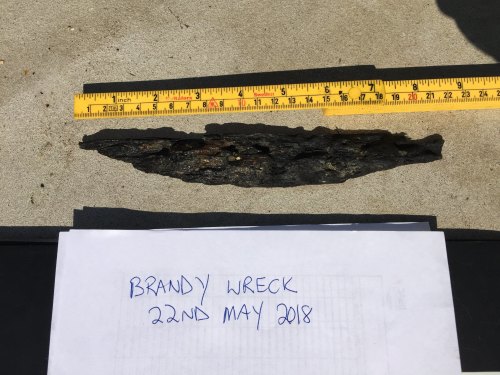
Section of highly degraded timber measuring approximately 216 mm in length by 31 mm at its widest point. The ends taper to a point, in a regular fashion that seems a deliberate aspect of the timber rather than part of the process of degredation. At least five nail or bolt holes are apparent in the face of the timber, further differentiating the piece from a section of unworked natural wood. The function of the timber is unidentifiable from the data available. As it has been recovered from a wreck it is likely to relate to the vessel itself and can tentatively be interpreted as a ships …
Created on: Friday 1st June 2018
Last updated: Thursday 26th March 2020
Spatial data recorded.
Record ID: MAS-D100173
Object type: CLOCK
Broad period: NINETEENTH CENTURY
County: Kent
Workflow stage: Published
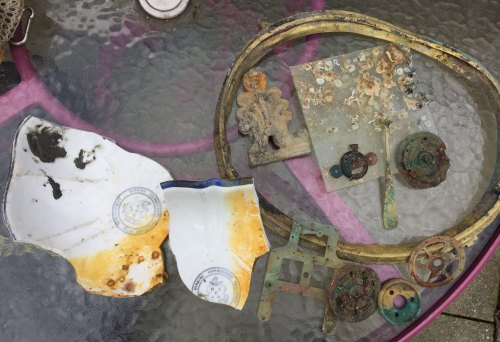
This record refers to the clock parts recovered as part of a group of finds. The finder described the items as 6 clock parts, the square glass from the clock face and the copper clock face from a grandfather clock, which suggests these finds represent parts of two separate clocks.
Three of the clock parts, manufactured in a copper alloy, are circular and bear teeth around their circumference indicating they are part of the clockwork mechanism. Two other parts, also in copper alloy, are circular but without evidence of teeth. One has three screw holes arranged around a central circular…
Created on: Wednesday 2nd May 2018
Last updated: Thursday 9th April 2020
Spatial data recorded.
Record ID: MAS-F100110
Object type: POST
Broad period: POST MEDIEVAL
County: East Sussex
Workflow stage: Published
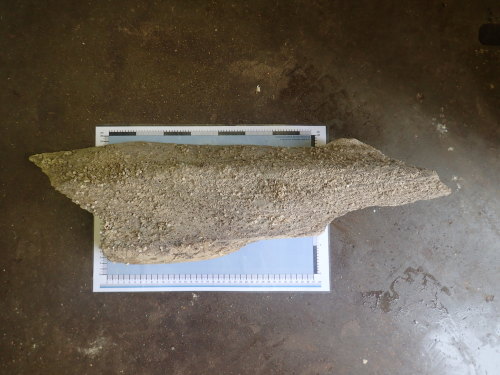
Heavily eroded and abraded timber fragment with marine borer and growth present. As it is so worn, it is difficult to tell what type of wood it is and whether this fragment was originally completely shaped and worked, or just partially worked to achieve its function. The timber does not exhibit any evidence or staining from fastenings, however, there is one hole that could have been a fastening point at some stage.
It is thought that this fragment may be a broken post or groyne timber that has come from a beach rather than material relating to a wreck. Groynes are wooden barriers bui…
Created on: Wednesday 23rd August 2017
Last updated: Tuesday 8th May 2018
Spatial data recorded.
Record ID: MAS-D100042
Object type: BOWL
Broad period: NINETEENTH CENTURY
County: Dorset
Workflow stage: Published
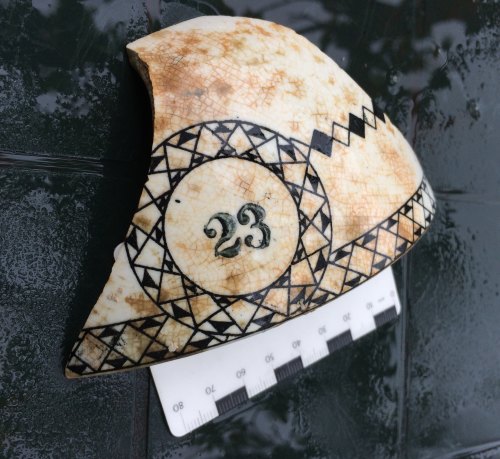
Fragment of white ceramic bowl or lid marked with black and white geometric design and number '23'. Number appears to be hand-painted or stamped. Found loose on the seabed with a little marine growth present. This is a naval issue bowl probably used for drinking rather than smaller, handled cups, as they were more practical on board a ship. The number refers to the mess number, and the bowls were designed to be stored upside-down. The find dates to the late 19th or 20th century.
Created on: Monday 29th May 2017
Last updated: Tuesday 26th September 2017
Spatial data recorded.

Record ID: MAS-D100052
Object type: JUG
Broad period: POST MEDIEVAL
Workflow stage: Published
One badly damaged ceramic jug with marine encrustration. The vessel is probably stoneware, but possibly glazed redware as there appears to be the characteristic 'orange peel' texture of salt-glazed stoneware visible in the photo, with the 'reeding' that you get round the rims of stoneware vessels. If this is the case it is almost certainly German in origin. The rounded shape would place it somewhere in the second half of the 16th century or first half of the 17th century.
Created on: Tuesday 23rd May 2017
Last updated: Tuesday 3rd October 2017
No spatial data available.
Record ID: MAS-O100031
Object type: TIMBER
Broad period: MODERN
County: Hampshire
Workflow stage: Published
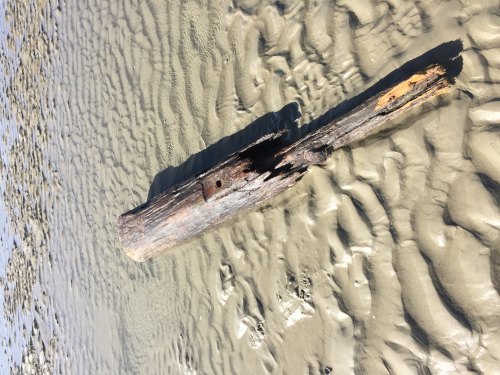
Possible ships timber or part of other marine or land based structure. Truncated rounded timber with hole and evidence of mounting plate for furniture, broken or rotted off at one end exposing heart wood and a knot in the wood. Approximately 2000 mm long and 600 mm in diameter. The undamaged half of the timber appears in good condition, implying a more recent date for the timber, whereas the other part appears to have suffered extensive degradation. The arrangement of damage to the timber suggests it may have been partially submerged during its useful life, possibly as part of a shore …
Created on: Thursday 9th March 2017
Last updated: Friday 21st February 2020
Spatial data recorded.
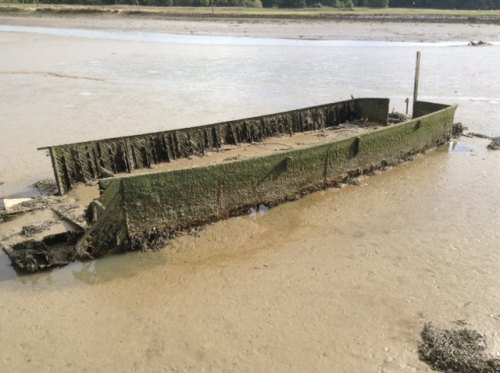
Record ID: MAS-100012
Object type: LANDING CRAFT INFANTRY
Broad period: MODERN
County: Suffolk
Workflow stage: Published
This hulk is situated on the River Deben, just outside of Melton (Suffolk) and is estimated to measure 11.5 m in length and 3 m in width. The structure is rectangular in shape with squared edges and straight sides. One end suggests the presence of a bulkhead and a hatch or doorway, while the other end is missing. Parts of possible rudder components are located close to the bulkhead, suggesting that this is the stern. Internal frames can be seen throughout the remaining structure; estimated measurements reveal a spacing of approximately 0.42 m. The hull is constructed of wood in a doubl…
Created on: Friday 30th September 2016
Last updated: Monday 10th October 2016
Spatial data recorded.
Records per page: 10 20 40 100
Sort your search by:
Which direction?
Total results available: 14
Search server index: asgard
You are viewing records: 1 - 14.
Search statistics
- Total quantity: 19
- Mean quantity: 1.357
- Maximum: 4
Filter your search
Object type
All Object type optionsCounty of origin
Broad period
Institution
Material
Workflow
1 - 14 of 14 records.

About us
About our site

Data labs
Find us
Wessex Archaeology
Portway House, Old Sarum Park
Salisbury SP4 6EB
T: +44(0) 1722 326867
E: